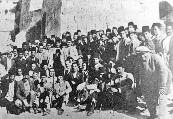
Pictured: First Arab Workers’ Congress in Palestine, Jaffa, 1930
LOS ANGELES (USA), September 12— “If another future is possible [in Palestine],” wrote Andrew Ross in 2019, “then perhaps its seedlings can be found in the work of labor advocates and organizers.” This impressed our reading group while discussing his book Stone Men: The Palestinians Who Built Israel.
“The people we know fighting the Zionist genocide and ethnic cleansing in Palestine rarely mention Palestinian workers,” said one member. “Olive farmers, herders, physicians, merchants who sell crafts, but not workers.”
That’s a big omission. For example, Ross mentions that the first (1987) intifada “was launched by a call for a general strike, to be backed up by commercial boycotts and tax refusals.”
We had read Ghassan Kanafani’s important 1972 book The Revolution of 1936-1939 in Palestine. It has a critical chapter on “the workers.” What happened to them?
The working class in Palestine arose in the 1920s. By 1926 it included 25,000 agricultural laborers and 17,000 construction workers. Two thousand railway workers played a key role in a new trade-union movement. Only about 1,000 Palestinians worked in industry.
The early 1930s saw increased migration from the countryside to the cities. Many new proletarians got construction work from the British imperialists. They built roads and railways. They enlarged and improved the Haifa port. This undercut the Arab-controlled port of Jaffa.
Meanwhile, the Zionist Histradut labor union colluded with Zionist capitalists. They wanted “exclusively Jewish labor” to replace lower-paid Arab workers. Histradut even called racist strikes to enforce this.
Ross describes this process, and the rise of Arab workers’ unions to confront it. By the 1936 rebellion, almost no Arab worker in Jaffa, Palestine’s largest city, earned anything near a living wage. Many, jobless, had to return to families in the countryside.
The Communist Party of Palestine was mainly composed of Jewish workers. It recognized the need to “Arabize” itself but couldn’t. It refused to break decisively from Zionism. It fragmented and marginalized itself.
World War II spurred war production. Thirty thousand Jewish workers joined the British military. British authorities employed 28,000 Arab workers to build new factories, workshops, and British army bases. Private Arab agencies found jobs for more migrants from the countryside.
War-related trade disruptions spurred job creation in textile, clothing, footwear, timber, food and beverage, tobacco, and metal industries owned by Arab capitalists. Unionization efforts surged.
The “Nakba” (catastrophe) occurred during the post-war period. This ongoing crime permanently altered the homeland of the Palestinian masses. British imperialism and the new United Nations “partitioned” Palestine. This established an Israeli state on over half of Palestine’s territory.
By 1949, the new Zionist state had grabbed more than three-quarters of Palestine. The Hagana (precursor to the Israeli military) completely destroyed Jaffa and 530 villages and towns. The evidence was quickly buried by new Israeli settlements and forests of European-style evergreen trees.
Seven hundred fifty thousand Palestinians, including most of the workers, became refugees. Over 15,000 Palestinians were slaughtered.
Israel expelled 400,000 more in 1967, after annexing the West Bank, Gaza, Sinai, and the Golan Heights. The Nakba continues today with genocide in Gaza and ethnic cleansing in the West Bank. With bombing and occupation of southern Lebanon and the ongoing war with Iran.
Most remaining Palestinian workers became migrants in their own land. “Households that could not survive on subsistence farming or were newly landless had no choice but to hire out their male youth for day labor in Jewish workplaces” at low wages, reports Ross.
Some were allowed expensive travel permits to leave their villages for work. Often these came through black market “fixers” and extra-legal back channels.
Others risked arrest by going without permits. Israeli authorities usually overlooked this due to Israeli builders’ demands for cheap labor. “Many were adolescents, sleeping rough on construction sites or under trees” and only returning home on weekends.
This continues today.
Palestinian workers are key to making “another future possible.” A secular, multi-ethnic liberated zone free from exploitation. A communist future. Not just in Palestine, but everywhere. Its “seedlings” are not labor unions or “advocates” but the small actions we can take every day to spread communist ideas through Red Flag and the International Communist Workers’ Party.
A second article will say more about Palestinian workers today. And about the sharpening contradictions they expose in Israeli capitalism.
Read Genocide in Palestine Demands Communist Revolution here