Building Communist Collectives here Letter: Eleven Hour Day here
Building Communist Collectives
EL SALVADOR, October 1— “All you do is work and sleep. I get up very early in the morning because I take two buses to get to the factory on time,” said D. “And when I come back in the afternoon, it’s already dark, and I fall asleep on the bus. I wake up and realize I haven’t arrived yet. I get off and still have to walk another 20 minutes,” he concluded.
“My body is tired. My body can’t take it anymore,” said K. “When the team of workers doesn’t meet the quota set by the bosses, they won’t let us leave. With that increase in hours, I don’t think I’ll be able to handle it,” she added.
This was part of a discussion at a workers’ collective meeting about the government’s proposed reform: an eleven-hour workday, four days a week and three days off. It ignores the time it takes workers to get to the factories.
This proposal to condense the workweek into four days is not new. Thirty years ago, it was proposed by FUSADES (Salvadoran Foundation for Economic Development).
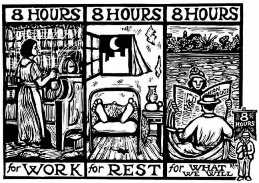
The current eight-hour workday is not a gift from exploitative employers. Rather, it was the result of intense struggles by workers to put an end to abuses when workdays lasted up to sixteen hours. The 1886 Chicago martyrs gave their lives to achieve these changes.
The eleven-hour workday does not improve productivity in the sense of reducing the time needed to produce a certain amount of goods. It does not raise wages, since that issue is not up for discussion.
The ones who benefit are the capitalist employers, who will no longer have to pay overtime. They will keep more of the value workers produce, and workers will get less of it. That means greater exploitation of the working class in order to reap more profits. The goal of capitalist production is to produce profits, not goods.
“We have consulted with all sectors, and they agree,” stated the labor minister, a sellout leader and a former union member.
“I’m a mother, and when I leave the factory, I go home to make dinner for my children and help them with their homework. With this reform, I won’t be able to do that. This is why I’m a member of the ICWP, fighting for communism,” emphasized M, a young worker.
She continued, “Under communism, we’ll work only as many hours as necessary. So we can spend more time with our families, comrades, and friends without worries, addressing any problems that arise collectively. It will undoubtedly be a better world,” M concluded.
The worker D contradicted her. “I’m more realistic. And I think that if it were necessary right now—without waiting any longer—I would take up arms to defeat the bosses once and for all.”
But aspiring to communism doesn’t contradict armed struggle.
“We must not lose faith in the masses. That moment will come,” said P, a worker leader. “We at the factory continue to recruit so that these changes toward communism can be achieved.
“We have met with three new workers this week,” he continued, “a couple and another woman. We gave them the Red Flag newspaper and discussed it with them. They’re very eager to keep reading it. We’re working to get them to participate with the factory collectives in our big end-of-year event.”
Letter: Eleven-Hour Workday: Bad for Workers, Good for Bosses
As a factory worker, I’ve been analyzing these new schedules: an eleven-hour workday, four days a week. Overtime—a way to earn a little extra—is no longer an option, while production quotas are set to rise even further.
Working eleven hours or more—plus the bus commute to the factories—means I am keenly aware that these new schedules impact not just our finances but our home lives. When we look for work, it isn’t just about earning money. We need schedules that align with our daily household needs and family care responsibilities.
I’ve discussed this with ICWP comrades. We are all furious and more determined than ever to defeat the bosses. We have to keep a close watch on our children, so they don’t go astray. They are influenced by a capitalist system that permeates the social media they access.
Then there is the issue of rest time. These new schedules would force the entire factory workforce to start work around 6:00 AM and finish at 8:00 PM.
We’ll have to get up even earlier and will arrive home late at night. If there are young children, they need help with homework or school supplies. And what about picking up food in town to get through the next day? How are we supposed to manage that?
There is no doubt that these new schedules benefit the boss, boosting daily quotas and profits, while never benefiting the working class. We must continue organizing the International Communist Workers’ Party (ICWP) in every workplace. We must defeat the bosses’ rotten system once and for all. And this must happen on a global scale.
—Red Worker in El Salvador
Learn more about communist political economy here
Read a short introduction to Marx’s Capital here