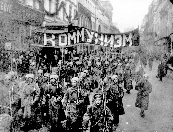
Celebrate Armed Struggle for Workers’ Power
On November 7, 1917 (old style: October 25) the Russia Revolution began in Petrograd, then capital of Russia with an armed insurrection organized by the Bolsheviks. They successfully took control of key locations, including the Winter Palace—seat of the government.
The next day, a full-scale uprising erupted as a fleet of Bolshevik sailors entered the harbor. Tens of thousands of soldiers rose up in support of the Bolsheviks. Red Guards occupied government buildings.
That fall, more than a million workers had participated in strikes. Many were Bolshevik organizers or supporters. Industrial workers in Petrograd and Moscow, miners in the Donbas, metalworkers in the Urals, oil workers in Baku, textile workers in the Centrak Industrial Region, and workers on forty-four railway lines. Workers established control over production and distribution in many factories and plants.
The Bolsheviks had organized for “Peace, Land, Bread,” an end to the war, and workers’ power. They declared communism as their ultimate goal.
Pro-capitalist liberals united with monarchists in a counter-revolutionary force. Within months, fourteen imperialist powers sent troops to help the counter-revolutionaries. The Bolsheviks organized more than five million workers and peasants into a Red Army. They also organized among soldiers of the invading armies. By 1920, big revolts among rank-and-file soldiers forced the imperialists (except Japan in the far east) to withdraw.
The Bolsheviks had inherited an economy in disastrous disarray. Famine was widespread. Their short-term solution was “war communism.” Its key was a state grain monopoly. It would requisition agricultural surplus from peasants and ration food for the urban population. It would jump-start production and bypass currency that inflation had made useless.
Factories sent worker-detachments to the countryside to collect desperately needed food. But the Bolsheviks had only a limited base among the peasants. And they did not mobilize the worker-detachments to fight for actual communism. Only in isolated cases did they take a sharp class line to rural wage laborers or to organize communist study as well as party cells.
Once the counter-revolution was defeated, some forces no longer supported the Bolsheviks. Serious problems arose because Bolsheviks had fought only for political leadership, not ideological leadership. For power, but not for communism.
Soldiers, Sailors, and Workers: Key to Revolution
The Bolsheviks demonstrated that the masses of workers, soldiers and sailors can be won to making a revolution and taking power for the working class. We have much to learn from them!
But their fatal error was their lack of confidence that workers and soldiers could understand the need to fight directly for communism.
The Bolsheviks retreated to the New Economic Policy. That meant more openly capitalist relationships. They incentivized the masses to seek personal gain. They retreated from the goal of building communism. Instead, they took the means of production from private capital and put it into the hands of a party-led state. But they kept capitalist economic relations (wages, money, markets). The party itself would become the core of a new capitalist class.
Today we know that soldiers, sailors, workers, and youth are capable of understanding communist ideas and fighting directly for communism. We work to unite our class worldwide in one mass international communist party. Mobilizing the masses for communism is our guiding principle, now and after the revolution.
The Russian masses proved in 1917 that the working class can rise and take power. We’ll do it again!
But our communist world will be very different from the socialism of the Soviet Union. Communist workers’ power will immediately end capitalism’s core element: a money-based economy.
Nobody will work for wages to buy what they need. Instead, our International Communist Workers’ Party will lead masses to work and share based on our commitment to each other.
Workers already produce everything. In communism, the producers ourselves will decide what’s needed. We’ll organize the work and distribute the fruits according to need. No markets, no money, no barter, no exchange – just sharing!
Humanity will be able to live as the one huge family we really are.
Communism will have no “government” separate from the mass communist party that welcomes everyone into its ranks. The masses, organized as interlocked party collectives, will participate directly in decision-making.
This mass communist party will weld the working people of the world into one powerful force. No longer will bosses be able to use nationalism, religion, sexism, or racism to fool us into fighting our working-class siblings.
Join us in celebrating our revolutionary past and building the communist future!
Read more about the 1917 Russian Revolution here