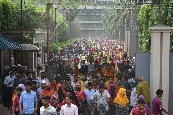
Over four million workers produce over $38 billion annually in profits for the garment bosses (after expenses). That is, a worker who gets $1200/year produces $9500/year in profits for the garment industry.
The government has promised an unspecified wage increase. But even if the workers’ demands were met, they would get only $2880/year. A pittance compared with the profit the bosses steal from their labor!
Workers discuss cost of living here Produce for Need, Not Profit here
Workers Discuss War and the Cost of Living
EL SALVADOR, November 16— “In my family we can no longer cover all the expenses,” said E, a bank worker. “While the capitalists defend their profits and their military interests, we workers face layoffs, insufficient wages, and an increasingly difficult cost of living to sustain.”
“We workers have no side to defend in the capitalists’ wars. Our struggle must be international and communist,” said C, who works in a plastic factory.
Six workers gathered at a comrade’s house for a dinner meeting. It was going to be a barbecue, but meat cost too much. So they ate chicken. Someone else couldn’t come because he couldn’t afford gas.
The war against Iran, launched by the United States and Israel, doesn’t stop with killing our class siblings far away. Its consequences reach ports, factories, transports, and workers’ homes in many countries. Restrictions and disruptions to maritime transit through the Strait of Hormuz, a critical route for the global transport of oil and natural gas, affect the movement of goods and increase economic uncertainty worldwide.
D also works at the plastic factory. He said, “The consequences of these wars cross borders. I used to have enough to buy food but it’s no longer enough to survive. We are living in difficult times, increasingly in debt. We fear not knowing how to continue. Those who make the decisions to fight and kill are not the ones who suffer the consequences. Workers pay the costs and face shortages. We are used as cannon fodder and to kill our class siblings.”
War hits workplaces
At Iran’s Shahid Rajaee port, the reduction in ship traffic affects workers at contractor companies. Port workers have reported cutbacks and layoffs. An employee of a cargo dispatch company stated that he hadn’t been called to work or paid for four months.
Behind the trade and oil figures are workers who lose their incomes and families who struggle to survive. We don’t decide wars or control trade routes, but our lives and jobs are trapped in the decisions of governments and companies that defend their economic and military interests.
Who protects our needs?
When oil and transportation become more expensive, production costs and prices of food and other essentials also rise. Wages, in contrast, don’t rise. Working families end up adjusting their spending, while companies seek to protect their profits.
“We, the working class, are already living on wages that don’t cover our basic needs,” said J, another bank worker. “Every price increase deepens that reality. For those who live paycheck to paycheck, losing hours of work or becoming unemployed can mean not having enough to feed their families.”
Governments talk about national security, stability, and negotiations. But none of them centers workers’ needs. They are starving us to kill our class siblings.
No power represents our interests. We don’t have to choose between the US, Israel, Iran, China, or Russia. Their rivalries respond to their own state, economic and military interests.
Our response must be international and communist
“As the working class, we share a reality: we produce the wealth of society, but we do not decide how it is used or for whom it is produced,” said comrade A. “From factories, fields, offices, homes, shops, and services, we have the capacity to organize and fight collectively.”
She continued: “Our strength is not in supporting one government against another, nor in relying on reforms that keep capitalism intact. It is in building an international communist struggle of the entire working class against all imperialists and against the system of exploitation.”
What can our collectives do?
Take this discussion to co-workers, family members, and neighbors. Share our experiences, organize conversations. Distribute and discuss Red Flag and invite other workers to participate in ICWP collectives. In these ways we can turn indignation into consciousness, organization and collective struggle. We can strengthen our ties with workers in other countries.
We fight for a communist society without classes, money, or exploitation. Where production and distribution are organized collectively to meet human needs, not to enrich a minority or strengthen their armies.
We must end imperialism and build communism! We have a world to win!
Produce for Human Needs, Not for Profits
EL SALVADOR, November 15—”Why do the profits of a minority take precedence over our needs? As workers, we need to understand not only who appropriates the fruits of our work, but also how capitalism organizes production to accumulate capital,” said A.
“Let’s think about a shirt. When someone makes a shirt to wear or share with another person, they produce an object with use value. It serves to clothe and satisfy a need. But when a factory produces thousands of shirts to sell them, they become commodities. The shirt still has use value, but it also has exchange value within commercial relations. Under capitalism, its production is organized to generate profits and accumulate capital, not to ensure that we all have clothes.”
As wage workers, we create new value through our labor. The value of our labor power is expressed in our wages. The additional value we produce beyond that equivalent constitutes surplus value, which the capitalists appropriate. Profits are one of the ways in which this surplus value manifests itself. Employers do not create that value simply by virtue of being owners. They appropriate the results of wage labor.
“So, these differences raise questions that we must discuss in our collectives. Do we produce material wealth or value? What is the difference between making products to meet needs and producing commodities to make a profit? How will we organize work when it is no longer subordinate to capital? Understanding these issues is essential to developing our vision of a communist society,” added C.
Communism does not mean stopping the production of clothing, food, housing, or technology. It means transforming the social relations of production. We will continue to collectively create and share useful products, but without organizing labor to sell commodities, accumulate capital, or enrich a minority.
“In communism, we will continue to produce material wealth to meet human needs, but production will no longer be organized through commodities, value, and capitalist accumulation,” said O.
As communists of the ICWP, we do not fight to obtain a larger share of capitalist profits or to become better beneficiaries of this system. We are fighting to root out exploitative relations and transform the relations of production to meet human needs.
We need to collectively discuss and understand how to build that society without wages, money, or social classes. We do not want to produce for the profits of a few. We want to produce for the lives of all!
Learn more about communist political economy here
Read a short introduction to Marx’s Capital here