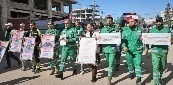
October 7— Three years ago, thousands of Gazans working in Israel had their work permits abruptly revoked. The Zionist state secretly arrested them as illegal. They were imprisoned under vile conditions, tortured, and humiliated. Several were killed.
Including the West Bank, over 140,000 Palestinians’ permits were cancelled. After October 7, 2023, residential construction in Israel fell by 95 percent. Farm production declined by 80 percent.
The contradiction between super-exploitation and genocide has shaped Zionist policy toward Palestinian workers since June 1967. That year, Israel occupied the West Bank and the Gaza Strip. Defense minister Moshe Dayan called the occupied territories “a supplementary market for Israeli goods and services … and a source of factors of production, especially unskilled labor, for the Israeli economy.”
Masses of angry, unemployed, expropriated, and displaced Palestinian workers threatened the Zionist rulers. It would be prudent and profitable to superexploit them as cheap labor within “Israel.” While excluding them from the Histadrut labor organization.
Palestinian workers were, and are, limited to jobs that Jewish workers don’t want. At wages that Jewish workers wouldn’t accept. Over one third of employed Palestinians worked inside “Israel.” Two-thirds of those with legal permits have been construction workers. Then and now, profit-hungry contractors arrange for many more to work illegally at great hardship and risk.
Border-crossers who lived in the West Bank and worked inside Israel saw and resented their second-class treatment.
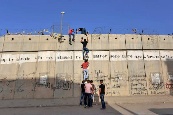
In 1967 the Zionists also began building “settlements” in the West Bank. They needed skilled masons to quarry and dress the stone. And construction workers to build homes, public buildings, and even the walls that fenced them in.
The settlements are illegal under Israeli and international law. But they grow daily. About 11% of Palestinians employed there work on land stolen from their families.
But the Zionist plan was to drive out Palestinians altogether. In 1987, a general strike helped to spark the first Intifada (uprising). Israeli labor policy shifted to workers from eastern Europe, Africa, Asia, and Latin America.
Many migrants overstayed their visas. Their numbers peaked at one-eighth (17%) of the Israeli workforce. Refugees from Eritrea, Darfur, and Sudan joined them. The Zionist ethnonationalists saw this as a new threat. “Migrants are invited to Israel only as workers, not as human beings,” observed an Israeli sociologist. By 2005, many non-Jewish migrants had been forced out.
Employers again saw Palestinian workers as “human gold.” Politicians hoped that employment would “pacify them.”
Until October 7, 2023. The number of Palestinian workers in Israel was close to an all-time high. Since then, the Zionists favoring genocide have overtaken those for super-exploitation.
Imported labor is rising. Finance Minister Smotrich boasted in 2024 of bringing “over 20,000 foreign workers into the country since the beginning of the Gaza war.” He announced plans to recruit 65,000-80,000 more from India, Sri Lanka, and Uzbekistan. Around 270,000 migrants currently work in “Israel.”
Palestinian workers continue to resist, individually and collectively. They resist under fascist conditions that include violent Jewish settlers alongside official government repression. They resist genocide. They resist exploitation—mostly outside of formal trade unionism.
“The Only Solution: Intifada, Revolution”
A recent survey of Palestinians in the West Bank and Gaza found massive dissatisfaction with the Palestinian political system. Most feel unsafe. Few expect to see a Palestinian state anytime soon. Fatah remains extremely unpopular. Hamas is losing support.
But almost three-quarters opposed disarming Hamas while Israel occupies Gaza. Among regional actors, Ansar Allah (the Houthis) had the most support even before their September revolution. Half the respondents said that armed resistance has been effective.
Only communist revolution has the potential to end both genocide and exploitation in Occupied Palestine. That would require Palestinian workers fighting for their class interest instead of “national interest.” And building bridges to international workers superexploited by the same Zionist bosses.
Organizing Jewish workers, soldiers, and youth for communism can create the conditions for some of them to join this struggle. Like how armed resistance groups formed inside Fascist Italy and Nazi Germany. Only communist struggle will win those raised to commit genocide to turn their weapons on the Zionist state and join Palestinians to fight for liberation.
None of this will happen automatically. Or overnight. Nothing is guaranteed.
But the increasingly bold communist work of Jewish and Arab ICWP comrades in Tel Aviv shines a light in the darkness. We ask all readers of Red Flag to share it everywhere. Especially in Palestine. The whole world is watching.
Read Part I of this article here
Read Genocide in Palestine Demands Communist Revolution here