
Ending Drug Addiction here ♦ Hammer and Rock here ♦
Ending Drug Addiction Requires a Society Based on Collectivity and Human Connection
After the Chinese Revolution in 1949, one of the most devastating crises the new government faced was mass opium addiction. Generations had been ravaged by the opium trade. There were seventy million opium addicts. Yet within only five years, the Chinese masses led by the Chinese Communist Party achieved what many thought impossible: near-total eradication of opium use.
Addiction had thrived under conditions of imperialist exploitation. The revolutionary state fought, at least in its beginning years, to put collective welfare over profit. The masses joined the fight. The material basis of addiction was removed.
The campaign was inspired by communist ideas to end opium addiction as part of building a society to meet the masses’ needs. Addicts were treated not as criminals but as victims of imperialist exploitation. They were offered medical detoxification, support, work opportunities, and above all, a sense of social purpose. Instead of growing poppies for opium and money, farmers were encouraged to grow nourishing food. Dealers and traffickers faced legal consequences, but ending addiction—not punishment—was the guiding principle.
What made this possible was collective will and effort. After years of fighting successfully for revolution, the masses understood that their liberation required freeing themselves or their relatives from opium addiction. Families were encouraged to help addicted relatives.
Contrast this with our current crisis: addiction fragmented into private pain, pushing profit-making drugs and digital “dopamine machines.” Capitalist medicine treats symptoms while the capitalists continue to exploit and attack us. To end addiction, we need a revolution that, this time, destroys capitalism and builds communism, which ends all exploitation and meets the masses’ needs.
Capitalism pushes disconnection. We cannot “treat” addiction in isolation from its roots. Liberation requires transforming the capitalist system that breeds addiction. Our task is to replace craving with connection, and profit with purpose, capitalism with communism.
China’s lesson teaches us that when the masses work towards creating a system based on collectivity and human connections and replace the system based on profit and money, the masses can and will overcome even the most entrenched epidemics.
See Mobilize the Masses for Communism here for an explanation of how China ended up capitalist.
Letter from Los Angeles: Between the Hammer and the Rock
“Mama, why’s there a teddy bear and balloons on the corner? What does the sign say?”
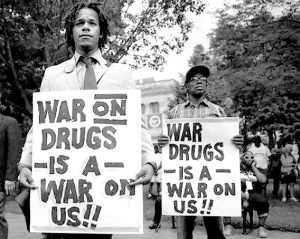
It was the early 1980s. The neighborhoods where I lived and where I taught were ravaged by drugs, gangs, and the LA Police Department. The altar on our corner memorialized one of the many young victims, mostly Black teenagers, of that genocidal attack.
Their grandparents were part of a migration of Black workers during World War II. They lived in Watts and other segregated neighborhoods and worked in steel, tire, and automobile factories.
Their parents were the 1960s generation who fought against segregation, racism, and imperialist war. The revolutionary potential of Black workers and youth shook US imperialism to the core. And the empire struck back.
The US economy declined after the US defeat in Vietnam. The 1973 OPEC oil embargo revealed its weakness. Factories began to close. Beginning in the 1970s, peaking in the 1990s, and continuing to this day, the US ruling class developed a genocidal strategy of flooding segregated Black neighborhoods with drugs, notably crack cocaine.
Crack was relatively inexpensive and highly addictive. It allowed the US bosses to destroy thousands of Black and other workers by hooking them on drugs. It set people up for arrest and police terror. It justified the growth of a gigantic prison-industrial complex.
Young people, robbed of a future, turned to gangs and drugs. The number of murdered Black males doubled. Politicians passed intentionally racist laws like the 1986 federal law which mandated penalties one hundred times harsher for possession of crack than for more expensive powder cocaine. In the early 1970s, there were 360,000 prisoners in state and federal prisons. That grew to more than a million and a half by 2009.
I taught and organized for communism in a community trapped, as Mike Davis wrote, “between the hammer and the rock.” Many young people suffered the consequences of this war. Chris, an honor student whose father had been medevacked out of Vietnam, was murdered in a drive-by at a hamburger stand. Hector, a Colombian immigrant, was caught up in the family business of drug dealing and spent decades in prison. Darrel, who fought the Ku Klux Klan with our comrades in 1992, was murdered at the corner liquor store. La Chulada de Morro, Carlitos, who marched on May Day and gang-banged on Monday, was murdered by drug war rivals.
Boris, who escaped the lure of drugs and gangs, joined Hector and others to march on May Day. Casey, Maria, Douglas, Alonda, Axel, and Sylvia understood the stakes and fought for a communist world. Andy, who became a communist, joined the military to organize soldiers. He inspired comrades to do the same. He is still a party organizer today.
As the US empire spirals in decay, desperation spreads. And so does resistance. Survivors of these wars join today’s young people in the streets. They are walking out against ICE raids, protesting the genocide in Gaza, and looking for answers. Many welcome Red Flag. They are the future.
—Retired from the classroom, but not from the class struggle