
Marx vs Kropotkin here ♦ Paris Commune here ♦
Marx versus Kropotkin
USA, November 12— “What do you know about the Paris Commune?” a comrade asked a Red Flag reader at a Palestine vigil.
“Nothing!” he replied.
“That’s gotta change,” said the comrade.
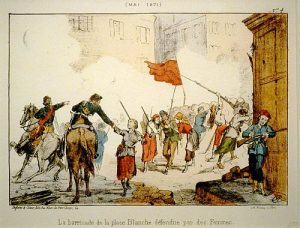
The Paris Commune of 1871 was the first time (after the Haitian Revolution of 1804) that workers took power and used it to organize society in their own interest. (See below)
The Communards had stormed heaven, Marx and Engels declared. The Commune “was the positive form of a republic.” It would “not only supersede the monarchical form of class rule, but class rule itself.” It started to show how “the proletariat organized as the ruling class” could begin to “end capitalist property relations.”
Communists and anarchists drew some of the same lessons from the Commune. The absolute necessity of internationalism. Workers must destroy the institutions of capitalist class rule. “The working class cannot simply lay hold of the ready-made state machinery, and wield it for its own purposes,” Marx and Engels wrote.
But what should replace it?
Marx on the Commune
While resisting the German invasion, Paris workers had replaced the French army with a mainly working-class National Guard. “This fact was now to be transformed into an institution,” said Marx.
That institution was “a working, not a parliamentary body.” Its member received workers’ wages, not privileges. They could be recalled. With no police or standing army, the Commune – the workers’ state – would not repress the masses.
A new draft Communal Constitution called the Paris Commune the model for every French municipality. A national militia “with an extremely short term of service” would replace the army. District assemblies would elect representatives to a National Delegation in Paris.
“The merely repressive organs of the old governmental power were to be amputated,” Marx wrote. Any of the old government’s legitimate functions would be “wrested from an authority usurping pre-eminence over society itself.” Such functions would be conducted by “the responsible agents of society.”
The Commune was “a working-class government.” It was “the product of the struggle of the producing against the appropriating class.” It was “the political form under which to work out the economical emancipation of labor.” It would “serve as a lever” for destroying the economic basis of class society, “and therefore of class rule.”
“If co-operative production is to supersede the capitalist system,” Marx declared, “What else would it be but communism?”
Kropotkin on the Commune
The anarchist Kropotkin disagreed. He admired the Communards’ spirit but thought they were mistaken in simply replacing one government with another.
Kropotkin credited Marx’s International for clarifying that “The existing development of industry will force a great economic revolution upon our society; this revolution will abolish private property, will put in common all the capital piled up by previous generations.”
The problem, he said, was its political form.
“German socialists,” he said, advocated “the popular state.” It would “organize production and exchange and generally watch over the life and activities of society.”
Italian and French socialists, he said, doubted “if such a state could ever exist; but if it could, it would surely be the worst of tyrannies.” Instead they proposed anarchy: “the total abolition of the state, and social organization from the simple to the complex by means of the free federation of popular groups of producers and consumers.”
Socialists agreed on this as a long-term goal, but not an immediate program. Kropotkin admitted that the anarchists lacked a clear, practical plan supported by existing workers’ organizations. The theory needed to be rooted in some practice. But how could this exist “without laying hands upon property?” Without winning over the masses?
With the Commune, “the people of Paris proclaimed an essential anarchist principle, which was the breakdown of the state.” But they then proposed a needless national government. And, Kropotkin added, “There is no more reason for a government inside the commune than for a government outside.” Everything could be left to the “free initiative” of producers’ and consumers’ groups.
Marx and Engels saw the Paris Commune as a material starting point for theorizing the form of workers’ power. And then putting that theory into practice. Kropotkin didn’t.
We’ll return to Kropotkin’s questions. But we agree with Lenin that, despite its errors, “the Commune taught the European proletariat to pose concretely the tasks of the socialist revolution.”
The 1871 Paris Commune: A Very Brief Introduction
The Commune arose amid the French army’s defeat in the Franco-Prussian War (1870-71). Paris masses rejoiced at the fall of the hated Emperor Napoleon III. They refused to submit to the new German Empire.
Workers and soldiers made up the Paris National Guard. They mobilized armed masses to defend Paris against both the Prussian siege and the French capitalists’ new republic. In a fierce battle, the masses forced the capitalists’ troops and their whole state apparatus to retreat to Versailles.
The Central Committee of the National Guard organized each district to elect a representative to the Commune Council. Most were workers. About one third belonged to the International Workingmen’s Association (IWA). Marx and others had founded the IWA in 1864. Its members, all radicals, had different and often contradictory politics.
During the Commune’s brief existence, IWA members worked with previously non-political workers and allies. They reorganized public services on a non-hierarchical basis. Communists like Elisabeth Dmitrieff and anarchists like Louise Michel helped design and implement radical social reforms. These included free public education and the distribution of necessities.
The Commune’s errors included military missteps, hesitation, and weak ties to the countryside. These allowed the French and German capitalists to drown the Commune in blood after only two months. Political disputes inside and out of the IWA sharpened as surviving activists reflected on the Commune’s victories and defeats.
There is so much to learn from this world-historic struggle!
More from Red Flag on the Paris Commune here and here
Read Marx, The Civil War in France here
Read Kropotkin on the Paris Commune here
Read about the Haitian revolution here