
At Garment Factory Gates Today
LOS ANGELES (USA), December 3— “In El Salvador, they already tried communism,” said a Salvadoran worker. He was picking up cut or pre-woven and bagged fabric from a clothing factory where we distribute Red Flag. “And look at how people are doing now,” he said to the comrade.
“Well, the truth is, communism wasn’t tried,” replied the comrade. “Before the Salvadoran civil war, US capitalists dominated the Salvadoran economy through military dictatorships. The Farabundo Martí National Liberation Front (FMLN) was formed to liberate the nation and establish socialism.”
“Look,” he said, pointing to an article written by comrades in El Salvador, “there and in many other places, we are fighting for true communism.”
The comrade previously had several short conversations with this Red Flag reader.
Another young man approached the factory entrance pushing a wheelbarrow with a heavy yellow machine. He stopped and called for help on his radio. He was a mechanic, and the machine needed repairs.
“What’s that?” he asked the comrade.
“It’s a revolutionary communist newspaper. It talks about how we are organizing and fighting for a communist world.”
The worker’s eyes lit up. He asked, “How so?”
“In a communist world we will all work to meet the needs of all workers, not to enrich bosses.” The comrade touched the machine. “You see this machine? Workers built it. Now that it needs repairs, you must fix it.”
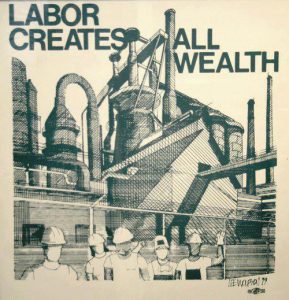
He continued, “You see this enormous factory? It was built by workers. Everything, the streets, the hospitals, the cars, is built by workers. And the bosses own everything. They get rich off our labor. They need us; without us, they cannot exist. We don’t need them.”
Two workers arrived to unload the machine, and the conversation ended. The mechanic took Red Flag.
Capitalist Versus Communist Factories
With communism, factories and machines will function differently than with capitalism. The Peruvian communist poet Cesar Vallejo visited the Soviet Union and wrote Russia in 1931: At the Foot of the Kremlin. The masses believed then that they were on their way to building a new workers’ state.
In the book, Vallejo says that the factory had become a new home. “In Russia, the home is no longer comprised of parents and children, but of all workers. It is a single home, made up of millions of parents and millions of children. Its emotional machinery has multiplied, been liberated, and amplified”.
Vallejo adds that the new Russian factory family has given its emotional values “a new foundation in history: work. Love inspired and founded on work! The kinship of work! Hence, the factory has become the matrix source of all relationships, feelings, interests, and ideas of every individual.”
Communists saw factories as the key place to build communist social relations. They wanted to change the focus from individual competition, inequality and exploitation to collectivity, equity, and the wellbeing of every human being.
In the early 1930s, over 42 thousand foreign workers worked in Soviet factories.
The Soviet masses, too, believed that they were working toward communism. This was their vision. But the Communist Party thought the path was through socialism. Factories still had to produce goods for markets and to turn a profit. Workers got wages and people could only buy what they could afford.
Socialism had a very sharp and poignant internal contradiction. They were fighting for communism, but they maintained capitalist social relations of production (wages, markets). The result was capitalism, not communism. We’ve learned both from the vision and from their failure.
The same contradiction arose in El Salvador and many other places. The masses were fighting for a communist future. Tragically, it didn’t turn out like that. But the International Communist Workers’ Party continues the fight for a communist world. Let’s embrace the vision and learn from the mistakes. We have a world to win!