

The State and Revolution: Lenin on the Paris Commune
Previous article: Marx and Engels saw the 1871 Paris Commune as a material starting point for theorizing the form of workers’ power. The anarchist Kropotkin didn’t.
“The Commune taught the European proletariat to pose concretely the tasks of the socialist revolution. The lesson will not be forgotten,” the Russian communist leader Lenin told comrades in March 1908. He made sure it wasn’t.
Nine years later, Russia was reeling from the world war. Soldiers and sailors returned home bloodied, hungry, and angry – if at all. Urban workers faced wage cuts as prices soared.
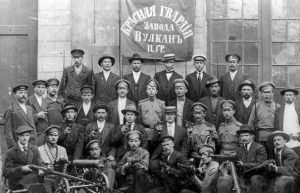
Unlike European socialists, communists and anarchists had denounced the Tsar’s imperialist war. They agitated and organized among troops. Strikes and demonstrations exploded in mid-February 1917 in the capital, Petrograd.
Communist factory cells grew rapidly and led some of the protests. Soldiers fraternized with workers. Mutinies erupted. Within days, the Winter Palace was taken. The tsar abdicated.
Bourgeois liberals and socialists dominated the new Provisional Government. Communists and anarchists wanted real revolution. Anarchists weren’t disposed to coordinate large-scale intervention. But the communist Bolshevik Party was. It changed from a small clandestine party to a mass party. Its ranks swelled.
The Provisional Government exiled Lenin. Preparing for power, he studied the Paris Commune carefully in State and Revolution. Published in July, much of it covered ideas popular among communists and anarchists. Especially the need to smash the capitalist state rather than trying to work within it.
More controversial was: “What is to Replace the Smashed State Machine?” Formerly, Lenin wrote, “the utopians busied themselves with ‘discovering’ political forms under which the socialist transformation of society was to take place. The anarchists dismissed the question of political forms altogether. The opportunists of present-day Social-Democracy accepted the bourgeois political forms of the parliamentary democratic state as their limit.”
The Commune had “replaced the smashed state machine ‘only’ by fuller democracy.” They abolished the standing army. All officials were elected, paid workers’ wages, and subject to recall. A quantitatively fuller democracy would create qualitative change: “proletarian democracy.” Instead of a state as a special force to suppress a particular class, it would become “something which is no longer the state proper.”
It would again be necessary, as it was in 1871, to suppress the bourgeoisie and crush its resistance. Lenin said that one reason for the Commune’s defeat was “that it did not do this with sufficient determination.” However, the “organ of suppression” is “the majority of the population, and not a minority” as had always been the case in class societies.
Without a “special force for suppression,” Lenin predicted, “the state begins to wither away. The majority itself can directly fulfil all its functions. And the more the functions of state power are performed by the people as a whole, the less need there is for the existence of this power.”
If the Russian revolution implemented the Commune’s “simple and ‘self-evident’ democratic measures,” it would unite the workers and most peasants. It would serve as a bridge from capitalism to socialism.
The Commune was the political form “at last discovered” which makes the “economic emancipation of labor” possible. The goal of political reorganization was “the transformation of capitalist private ownership of the means of production into social ownership.”
Anarchists wanted immediate abolition of all administration, bureaucracy, and subordination. Lenin thought this was unrealistic. It amounted, he said, to postponing the socialist revolution indefinitely “until people are different.”
“But to smash the old bureaucratic machine at once and to begin immediately to construct a new one that will make possible the gradual abolition of all bureaucracy–this is not a utopia,” Lenin declared. “It is the experience of the Commune, the direct and immediate task of the revolutionary proletariat.”
The new order would still need representative institutions. But they would be working bodies, not parliamentary “talking shops.” Elected representatives would carry out their own laws and “test the results achieved in reality.” And “account directly to their constituents.”
Right away, the “bossing” of state officials would be replaced by ordinary workers taking turns carrying out “the simple functions of “foremen and accountants.”
Building on existing capitalist large-scale production, this beginning “will of itself lead to the gradual ‘withering away’ of all bureaucracy,” Lenin concluded. “To organize the whole economy on the lines of the postal service, all under the control and leadership of the armed proletariat–that is our immediate aim.”
On October 25, 1917, Bolshevik workers and soldiers led masses to overthrow the Provisional Government. Lenin opened the Second All-Russian Congress of Soviets with the words, “We will now proceed to construct the socialist order.”
How would this evolve into communism? Lenin found no practice on which even to theorize about this.
We don’t agree with everything in State and Revolution, but it is a “must read” for analyzing the contradictions that quickly emerged, as the next article will show.
Read Part I (Need More Clarity on Communist Workers’ Power) here
Read Part II (Lessons of the Paris Commune) here