
Mobilizing for Communism here ♦ Communists Confronting World War here ♦ Fascism or Communism here ♦
Letter: What Does Mobilizing for Communism Mean?
“Mobilizing masses for communism” is “our guiding principle.” “Our program.” “An apt slogan.” All this in our original manifesto some fifteen years ago. By now we should have a better understanding of its meaning, based on practice.
I read every article in Red Flag carefully, especially those about our work. And it seems that there are two contradictory ways we understand “mobilizing.”
When a government “mobilizes” troops, it prepares and organizes them for active service. It musters or readies them. Mobilizing does not yet put them into action.
But “mobilizing” people can also mean organizing and encouraging them to act in a concerted way, to bring about a political objective. In this sense, “mobilizing” does mean putting them into action.
I understand “mobilizing for communism” in the second sense. We mobilize people to take actions now that, usually in small ways, advance the struggle for communism.
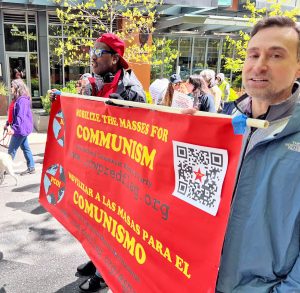
We mobilize them for communism when we convince them to distribute Red Flag. To march on May Day, join a protest, or come to a party meeting. To donate money. To write for Red Flag. To talk to friends and coworkers about communism. To find ways they can put communist ideas into practice in their daily lives. To join ICWP and enrich the collective with their experiences and ideas.
Building communist relationships makes it possible to do this. Doing and discussing communist work together strengthens those relationships. I think this understanding of “mobilizing masses for communism” is key to growing a mass party now. And how the party functions now is key to understanding and explaining how communist society will function
But some reports of Party work seem to reflect the first (military) concept of mobilizing. That is, the present task is to prepare friends now to do communist work in the future. In this model, building communist social relationships means creating a context to talk to people. And, hopefully, to listen to them. Building a mass base for the party now in order to build a mass party later.
Of course, no collective’s work is 100% one or the other of these. Both center personal-political relationships and struggle. But I think the two meanings of “mobilizing” are dialectical opposites.
Our party arose in a period of capitalist crisis and mass struggle. The “Occupy” movement in the US and elsewhere. The “Arab Spring.” This is another such period, galvanized by the Gaza genocide and open fascism. There are huge opportunities for us to grow.
We need to develop, spread, and enact the best possible understanding of mobilizing masses for communism.
—Fired-up comrade
Read the ICWP manifesto Mobilizing the Masses for Communism here
Letter: Communists Confronting World War: What Can We Learn from History?
Mearsheimer is a well-known U of Chicago and a fairly objective commenter on US foreign policy. I don’t know if his revelation about new deployment of nuclear-capable Russian missiles is accurate. Only time will tell. But the possibility, reminiscent of the 1962 Cuba crisis, indicates a world on pace for World War III.
Asia Times has reported France and Germany taking significant steps towards military conscription. US Congress has legislation to restart the draft. It’s not imminent but it exists.
I believe we can correlate current world events – the capitalist division into two blocs – with similar developments before the first and especially the second world war. The proxy war in Ukraine and threats to Venezuela, clashes between Cambodia and Thailand, the genocide in Gaza, and more – all could be mistaken for run-of-the-mill imperialist competition.
But their intensity, location, and critical number are something more significant. None of this is new or news. But it raises a question. How has the communist movement responded in the past to oncoming world war? More importantly, how should the masses treat these wars now?
Comrades in Israel struggled to put forward the fight for communism: “No” to following any capitalist. This is of course correct. Their experience might offer significant lessons. But a review of the old movements’ mistakes would be useful.
Lenin railed against any support of “our” capitalist during World War I. German communists were split, as were other parties. To their credit, the Bolsheviks clearly and consistently took advantage of inter-imperialist war to make revolution.
The later Russian and Chinese records were not so clear or good. Mao developed his United Front theory, allying temporarily with Chiang Kai-shek. The Soviets participated in Lend Lease and various military and diplomatic commissions with the Brits and Americans. None of these entanglements were either necessary or significant in a positive sense. They were all negative, ideologically perverse, and harmful.
It sure seems that millions in Venezuela are being won to supporting Maduro. Nationalism combined with intense, well-deserved hatred of US imperialism seems to be the driving force currently disarming the masses from communist revolution. I believe that this phenomenon will be prevalent. It consequently needs to be exposed, attacked, and defeated.
Historical evidence is clear: unity with any capitalist forces is a betrayal. We should do serious education, using Red Flag and other means, to save workers from this historical mistake. A mistake consistent with coalescing with any form of capitalism (which is what socialism is) is a deadly error.
I’m sure there are comrades more capable than me of drawing lessons from the errors of Germany before and during World War I or Spain before World War II and China and USSR during the war, Gaza and Venezuela today, and dozens of other situations. I just think that supporting the “lesser evil” is a strong current both historically and in today’s world. It’s a deadly sin.
—Thoughtful friend
Red Flag responds: Thank you for your letter. You and other readers might like to read an article about this that we printed in September 2024 here.
Letter: Fascism or Communism?
Fascism in Soviet Russia (social fascism) is the elephant in the room. Ignoring it gives free rein to the ruling class to discredit communism. And they sure take the opportunity to do so.
In France after World War II, communist ideas attracted a lot of workers. The Communist Party (which was not a true communist party) would get a third of the votes at national elections. The CGT was a powerful communist-based union. Many artists and intellectuals proudly claimed to be communists.
Now it is quite the opposite.
After the May 1968 rebellion, the bosses got scared and they orchestrated a propaganda war against communism. Newspapers, books, magazines, and so on were full of revelations about ‘communist’ horrors in the USSR – the Stalin cult, the NKVD, the gulags, the purges, etc., etc. The tone changed, too, about the French Revolution. The king and queen were now “martyred” by the revolutionaries.
In my small French town, very conservative, I had two friends who belonged to the Communist Party. They were loved and respected and they put a lot of work and dedication into spreading communist ideas. In fact, it was their life.
In the 1980s, they totally withdrew, embarrassed and ashamed because they felt they were associated with the mistakes and cruelty of what had become Fascist Russia.
They did not need to be. Communists must keep proudly defending their ideas – not by denying what happened in the USSR – but by condemning it. Purely and simply.
Social fascism was not communism. Communists do not fall back on cruel capitalist ways (prison, labor camps, famine, killings) to terrorize and exploit workers. Let’s quote Che Guevara: “Let me say that the true revolutionary is guided by a great feeling of love.” Che reserved hatred for the enemy.
As one of my older friends told me once: “Capitalism did not succeed the first time.” Same with communism. It is difficult and long work to convince people. Let’s not get involved in the extent, exaggeration, etc., of the events but instead admit and forcibly say that what happened in the USSR was not communism. It is not that hard.
—Comrade from France
Red Flag responds: We appreciate the comrade’s letter, and we have always said that the USSR was never communist. The comrade’s explanation of the French rulers’ anti-communist campaign after 1968 is helpful. But we think the letter reflects the impact of that campaign’s claims about what happened (or allegedly happened). We don’t agree that the term “social fascism” (in its commonly used sense) is an apt description of the USSR at any point. We expect that other readers will want to contribute to this discussion.