Immigrant Garment Workers Face Super-Exploitation
“Since we stay inside the factory, we don’t have to worry as much about being arrested by outside police,” said an undocumented garment worker from Myanmar in China. “But we cannot leave the facility at all. Without passports, we have to work and live completely hidden and cautiously.”
He works in a factory in Ruili City (Yunnan Province) along the China-Myanmar border. Tens of thousands of undocumented migrants work in Chinese border-zone apparel hubs.
They lack legal status. They are isolated and vulnerable to bosses’ abuse due to the constant threat of detention or deportation. Their super-exploitation generates super-profits. Not because of a few bad bosses. But because capitalism puts profit above human need and treats labor as a commodity to be bought as cheaply as possible.
The factory is part of a “shadow” supply chain that subcontracts for larger textile companies. In this way cheap goods get to corporate distribution networks and international apparel supply chains. Shadow supply chains account for 70%-80% of China’s total garment output. Almost half of all major global fashion companies like H&M, Gap, Nike, and Adidas are connected to them.
In 2024, a Chinese citizen, a long-time sewing machine operator, while working for a Shein supplier factory said, “Every day I work from 8 in the morning to 10:30 at night and take one day off each month. I can’t afford any more days off.”
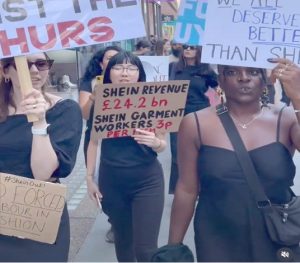
Shein is an e-commerce giant multi-billion-dollar global corporation and the world’s largest ultra-fast-fashion retailer. China exported over $150 billion of garments in 2025. Shein accounts for roughly one-third of that. Shein alone exceeds garment exports of countries like Bangladesh, Vietnam, and India.
Shein’s wealth comes primarily from shadow supply chains and the Hukou Migrant System. From excessive overtime, limited rest days, relentless production pressure, wage violations, and labor-law abuses.
The Hukou system is a Chinese government household registration program. It permanently classifies citizens as “rural” or “urban” based on their birthplace. Millions migrate to cities for manufacturing jobs but can’t transfer their legal registration. Thus, they can’t access public healthcare, pensions, or state education. They are forced to accept grueling, low-wage factory work.
This happens in Guangzhou’s “Shein Villages,” a dense network of small garment factories and workshops where both Hukou system workers and undocumented immigrants labor.
Same Enemy, Same Fight
An ICWP garment worker organizer in El Salvador said this: “This situation of Chinese garment workers exists here and worldwide. We can see the reality of life under capitalism. When we learn about Chinese workers—like those here, in Bangladesh, and elsewhere, who toil under this system and under that oppressor boss—it helps us to further extend the Party’s line. What we experience is what they experience on a global scale.”
He added that “in the factories here in El Salvador, while the rest periods differ slightly, the bosses’ repression and the cycle of production is the same. 100% of the profits end up in a few hands. Overproduction is rampant, yet they don’t give back any of the massive profits generated. They keep it all. We must intensify party work.
“We cannot stop or waste time when it comes to organizing the party,” he concluded. “Think of the millions we generate in the factories while we are forced to live penniless. The pittance they pay us barely covers our personal needs.”
A Los Angeles worker said, “I worked in the garment industry for fifteen years. All I got was sweat and a constant push for faster production. When the minimum wage went up, we had to turn out more pieces to try to keep pace, since we were paid by the piece. Rent was always high, and food prices too. Our wages were never enough.”
Competition among capitalist-imperialists worldwide is intensifying. Corporations search for greater profits. Workers are forced to produce more in less time and are forced to accept worsening conditions. Shein’s supply chain reflects the broader logic of capitalist production. Profit depends upon extracting more labor at the lowest cost possible.
Workers in China, El Salvador, the United States, and everywhere are tied together through the same global system of capitalist production and exploitation. The answer is not better regulation or corporate promises. Workers must organize collectively and build the International Communist Workers’ Party to overthrow the system. Let’s build an international movement for communism, a society organized around human need rather than profit.
Read Fight for the Day When No Worker Will Be Called Foreigner here