LOS ANGELES COUNTY (USA), July 26— “This is the first thing we’ve read about Palestine with a class analysis,” B commented. Our book club was discussing Stone Men: The Palestinians Who Built Israel, by Andrew Ross.
“This isn’t the first,” J reminded us. “Ghassan Kanafani’s book The Revolution of 1936-1939 in Palestine had fantastic Marxist analysis. But it’s unfortunately rare to encounter this perspective in books about Palestine.”
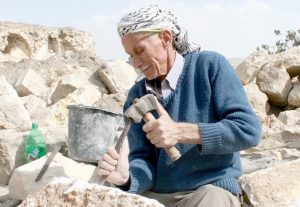
Ross writes about skilled Palestinian construction workers. His book includes information gleaned from conversations with them. It shows how everything about construction in Palestine reflected Zionist ideology and conquest. The materials, the architecture, the labor force.
We were discussing a section called “City on a Hilltop.” It’s about Rawabi. That was the first modern planned Palestinian city in the West Bank. Palestinian workers in a nearby village described it as an economic scheme cooked up by Qatari investors and Bashar Masri, a wealthy Palestinian real estate developer.
“What really struck me,” said J, “was how Masri was able to co-opt Palestinian solidarity without contributing anything to Palestinian liberation.
“It’s similar,” he continued, “to how liberals say that electing Kamala Harris would be some great liberation for all Black people. When in reality you just have a token ‘representative’ consecrated by the capitalist political structure. A token not accountable to anything but capitalist interests.”
The Palestinian capitalists of the West Bank faced violence at the hands of settlers and the Israeli state. And they employed Palestinians.
But they were using their position to exploit the Palestinian working class. They literally sold off their heritage and land, piece by piece, to make luxury housing developments. All this while flying Palestinian flags over their showrooms for model homes that Palestinian workers can’t afford.
The Palestinian Authority enabled this, seizing land by “eminent domain.”
Ross traces Rawabi back to the Oslo Accords (1993-95). Then-US President Bill Clinton brokered Oslo. The once-militant Palestine Liberation Organization (PLO) “recognized” the Israeli government. That Zionist regime anointed the PLO to “represent” the Palestinian masses. Together they created the collaborationist Palestinian Authority.
Oslo was supposed to be a step toward a “two-state solution.” But the Israeli rulers never intended to allow a Palestinian state.
The Oslo “peace process” ended a quarter of a century ago. But the Oslo Accords laid a continuing basis for international investment in Palestine. They promoted capitalist “economic development” and liberalized markets.
Among the 750,000 Palestinians expelled in 1948, and now among their descendants, are a few wealthy capitalists like Masri. Capitalists very comfortable with neoliberal economics. Eager to promote neoliberal ideas about “progress” and “modernity” among some skilled workers. And willing to work with the fascist Israeli rulers.
Construction workers at Rawabi told Ross about “exploitative, and often dangerous, labor conditions.” Three-month labor contracts let employers avoid paying benefits. Injured workers were callously laid off.
The “national struggle” for a Palestinian state can’t erase the class struggle.
“In the absence of an organized, robust, and coordinated working class movement that operates on solidarity with all working people (in Palestine and around the world), the vacuum is filled by these capitalist liberals,” J concluded.
“They are loyal to capitalist interests. They can use the veneer of Palestinian nationalism to push their agenda that only serves the interest of capitalism. All at the expense of Palestinians.”
We’ll write more as we finish the book. We think it’s worthwhile for others to read. So is the Kanafani book.
But the story of Rawabi alone shows why we can’t just shout “Free Palestine!” Free markets for capitalists, or freedom from exploitation for workers?
ICWP is confident that communists in the West Bank, in Gaza, and in “Israel” will unite to fight to end capitalism “from the river to the sea.”
Read Genocide in Palestine Demands Communist Revolution here