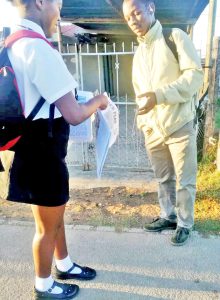
Southern California (USA), August 5— It’s a scary and confusing time for high school students. Many have seen ICE kidnap their neighbors off the street. Seen it in person, on social media, or both. Fascist terror and racism are more visible. The genocide in Gaza and Lebanon and the war in Iran cloud their futures.
And their parents’ and grandparents’ confidence that hard work would get you a good life seems like a bad joke.
But school is starting and students will do what they can. Some will bet on college. Some will learn a trade, working in construction or health care. Some will become industrial workers. Many will face unemployment, like most youths in other countries.
And some will join the military. They will hope to survive and to be rewarded with the down payment of a better future for their families. Many will be sent to attack other unemployed youths.
The Board of Education knows this. They organize schools to train you to follow orders. Not to think critically. History classes are designed to build patriotism. Every kid, every day, has to pledge their allegiance to the flag and the republic.
Communist teachers also know a lot of our students will be soldiers. Sent to risk their lives to kill their working-class siblings, to fight for an empire that sees them as expendable.
But communists also know that soldiers, sailors, and marines do not check their brains along with their cell phones when they report to boot camp. Enlisted personnel have organized mutinies, stopped massacres, fragged gung-ho officers. They have united in acts of rebellion in every war in history. In Russia in 1917, soldiers joined together with workers and peasants to turn World War I into a revolutionary. struggle.
Students in high school today are potential revolutionaries.
So are the Marines that we visit regularly on the streets of Oceanside, CA, outside of Camp Pendleton.
“These young men already have a sense of what’s going on,” said a comrade who went to talk to Marines for the first time in July.
Many people flatten military personnel into stereotypes. We spoke with one young man who opposed oppression in Ukraine and the genocide in Gaza. Another opposed communism but understood the role of oil profits in US involvement in the Middle East.
We discussed “following orders” and being told to do things they believed were wrong.
“I thought about this a lot before joining,” a Marine said. “I know that I would rather die than kill an innocent civilian.”
His statement had a strong impact on us and on his friends.
“It’s important for your actions to match your values,” a comrade responded. “But it’s even more important to have an impact on the larger situation.”
She talked about Hugh Thompson Jr. during the US war on Vietnam. He witnessed US soldiers killing civilians in the My Lai massacre, including elders and children. Thompson ordered his helicopter gunner to point the turret at the American troops. He warned that if they continued, he would open fire. His actions helped stop the massacre.
Later, we explained to two Marines what we meant by real communism. The first returned our literature, but his friend kept it.
“In theory that sounds good,” the first Marine said. “But human nature is another thing. There is always someone who wants to be on top.”
“In high school they have us read Animal Farm, where that’s exactly what happens,” a comrade replied. The Marine holding the literature nodded.
“We learn from past revolutions, from both their victories and failures. Sooner or later we’ll get it right,” the comrade continued.
The two Marines were close friends, but their friendship did not lead the one who kept the literature to return it. Despite the strong peer pressure that often exists among military buddies, our politics reached him.
Our final conversation was with a Marine who accepted our literature. We asked what he thought.
“I think it’s an honorable thing what you guys are doing,” he replied. He listened attentively, setting aside his lunch.
We shared how working-class people fight in wars, not the sons and daughters of the capitalist class. And how military personnel have at times turned their guns around and joined the working class in revolutionary struggles.
We really should have asked for his contact information.
“Our objective in our conversations with these Marines as well as with high school students is to activate their own agency, conscience, and capacity for thought,” said a new comrade. “In doing so, we plant the seeds of our communist message.”
We returned more committed to building personal ties with high school students and Marines. Those communist relations are what it takes for them eventually to lead others to turn the guns around and destroy the capitalist system.
Read Soldiers, Sailors, Marines: Crucial to Communist Workers’ Revolution here