
Writing as a Collective Process here ♦ “Efficiency” and Communist Social Relations here ♦
Writing as a Collective Process of Struggle
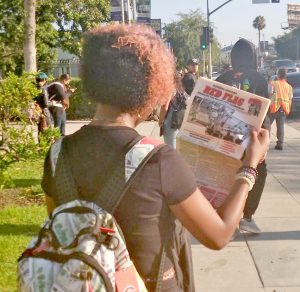
What does it mean to produce articles collectively? The Red Flag editorial collective wants to share a recent discussion. We want more readers to get involved.
Comrades and friends collaborated, in different ways, on at least eight articles in Volume 17 #11.
One comrade initiated the Ceuta article with a somewhat mechanical question. Another, closer to the events, wrote something else that opened up the discussion and centered the migrant workers. A third contributed links. After more research and discussion, the final article in print had a deeper analysis, still centering the working class.
The article about the death of Nolan Wells started by asking for input from members of a book club and other friends. Two comrades and two friends responded immediately. L also used comments from another friend’s social media. L got significant feedback on the draft, revised it, and sent it back to everyone on the original chat. One comrade responded.
“Collective input requires contributions and also responses to drafts,” reflected comrade L. “That is, political struggle about what is the main point, who is the audience, what is the main contradiction. And if the article is about our work, what is the self-criticism? That takes time.”
Comrade Y asked for advice. “I always send things to close friends, but I almost never get feedback beyond ‘looks good.’”
Two comrades reported some success getting feedback after using comments friends had posted on social media or sent in email messages. They used that feedback in creating final versions.
Comrade A talked about how we get articles from India and elsewhere. Comrades there provide information. Then he writes and circulates drafts. These often help generate other letters and articles.
Comrade R criticized the process of producing the article about visiting Oceanside. He noted that we strive to build communist social relationships, not to be “efficient.” He said, “We need to take the time to guarantee all voices in the writing process.”
R was self-critical for “not carrying out the necessary political struggle with the comrades that were initially part of the writing process.” That is “an indispensable part of building communist relationships.”
But he objected to the “radical rewrite” done by a comrade with “more of an expertise in writing.” He said that “a reliance on that circumvents the development of better writers and does not create communist relationships. Efficiency trumped communist relationships,” he concluded.
Others disagreed. They pointed out that this was not the first time an article started with a collection of individual reports. What does it mean to take political leadership in this situation?
“It’s not just struggling with comrades to get their pieces in,” a comrade emphasized. “It is posing a thesis: ‘I think the main point is this, the audience is this, the argument is this.’”
This process is “inefficient.” Since the original author hadn’t done it, someone else stepped up in the crunch, after five weeks, days before the paper went to press.
It mattered that the article should speak to high school students. And that it clearly conveys to them that we can do communist work in the military. And why it’s critical. That’s not about expertise or efficiency. It’s about communicating our line.
Comrade L summarized: “When you ask people for notes, ask them to reflect, not just remember.”
The contradictions that emerged in this discussion have not all been resolved. We hope this report encourages more comrades and friends to contribute to the paper and to our communist understanding of collective writing.
“The process should be mainly one of struggle, not of agreement,” comrade Y concluded. “I need to rethink my approach. To emphasize to my friends how important their input is to the party. And not be afraid of damaging our relationships by struggling over our party’s politics.”
Letter: “Efficiency” and Communist Social Relations
My Grandpa dropped out of school at fourteen to take over the family farm. He was very self-conscious about his limited schooling and always worked to improve his reading vocabulary.
A staple in my grandparents’ house was The Readers’ Digest magazine and Readers’ Digest Condensed Books. The magazine included condensed excerpts from popular print magazines, and features including vocabulary building. It was created in 1922. Its anti-communist politics reflected the Red Scare that followed the Russian Revolution. Its structure reflected the time management and efficiency in industrial production of the 1920s “American Plan” of factory organization.
The books had “condensed” versions of a few of the best-selling books published each year. One was “Cheaper by the Dozen,” written by two children of time-and-motion-study experts Lillian and Frank Gilbreth. The original book was a warm and funny portrait of a childhood. The condensed version stripped the book of its human element and its humor. It was a bare narrative of how to run an efficient household with a dozen children.
The Gilbreths would have approved of the efficiency of cutting out the human element and getting the reader to the point as quickly as possible. Their life work was in making factories as efficient as possible. In maximizing exploitation and increasing the profitability of factory work.
This is not our goal. Our goal is a communist society where production is for need, not for profit. Work will not be a “job” where you work as an appendage to a machine, to produce whatever you’re told to produce, for a wage that you spend to buy what you need to survive.
Creating communist social relations of production is not efficient. It requires time. Slowing down and listening. Caring, laughing and crying, as well as working. Thinking deeply about what we really need. Struggling with our comrades and fellow workers to fulfill the needs of us all.
Does the world really need more t-shirts? Should we be growing cotton or vegetables? How can we make sure that what we produce is not at the expense of the planet, the community, our own bodies and emotions?
Our political work needs to reflect those values today. How do we take care of each other while we struggle to mobilize the masses for communism? How do we work together, taking the time we need to really listen? How do we have the confidence in each other to struggle for change? How do we think deeply and collaborate in what we say and write for the masses?
I started this letter thinking about the use of AI in writing for the paper. But as I wrote it I could see that it had broader implications. That is exactly what happens when you think and write. That can’t be sourced out to an app.
—Comrade in Los Angeles (USA)
Read Mobilize the Masses for Communism here