EL SALVADOR, August 2— “When I read the article on communism and anarchism, a reflection came to me. I understand the historical differences, but what do the Paris Commune, the October Revolution, or the Chinese Revolution have to do with us today?”
“At first I also thought that they were distant events,” D continued, “but today I see that their lessons are still fully current. Capitalism has changed, but its essence remains the same,”
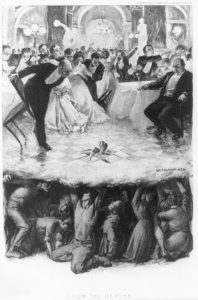
“Today, millions of workers collectively produce everything that sustains society: food, hospitals, transportation, technology and communications,” said A. “No capitalist produces on his own. All wealth is the result of collective work. However, that wealth continues to be concentrated in the hands of a small capitalist class. This contradiction shows that the problem is not only who governs, but who owns and controls the means of production. That is the material basis on which communism is built.”
A clear example is the garment sweatshops (maquilas). Thousands of workers participate producing a single garment. Some cut the fabric, others sew the pieces, others place zippers and buttons, while others iron, pack, and distribute it. Who really made that shirt or those pants? No one person does all the work; it was the collective effort of hundreds or thousands of workers.
However, when the garment reaches the store, the profits end up in the hands of the owners of the maquilas and the big international brands, not in the hands that produced it. Here the contradiction of capitalism is seen clearly: production is collective, but wealth is still appropriated by a minority. That is the contradiction that communism seeks to overcome by transforming the social relations of production.
“Many say that the problem is simply the state, that it is enough to abolish it for a free society to exist,” said D.
However, this idea ignores the fundamental problem. The State does not exist by itself. It arises because society is divided into classes. As long as there are exploiters and exploited, there will be a State that will defend the interests of the powerful. The decisive question is not only the State, but also the transformation of the social relations of production. If private property, the market, and competition continue to organize the economy, inequalities and new exploiting classes will re-emerge.
“Is that the main difference between communism and anarchism?” asked C.
Yes. Communism is not only about destroying the old state, but also about transforming the economic base of society. Production must be organized collectively, and the large means of production must become the property of all to meet the needs of the working class and not the profits of a minority.
Strikes, protests, and rebellions are indispensable. But history shows that, on their own, they are not enough. The Paris Commune, the October Revolution, and other revolutionary experiences teach that, without political organization, revolutionary leadership, and a communist program, struggles can be defeated, diverted, or absorbed by capitalism. Spontaneity can open the way, but it cannot replace the conscious organization of the working class.
That is why we study history: because it contains lessons for the struggles of the present. Our task is not only to know the past, but to build the future. That means organizing in every workplace, school, and community. Strengthen the International Communist Workers’ Party, distribute Red Flag, and turn every political discussion into an opportunity to develop class consciousness.
Revolutionary ideas only change the world when they become the organization, discipline, and conscious action of millions of workers. That is the main lesson that history and the task ahead leaves us.
Read about the Paris Commune here and here
Read about the October (1917) Revolution in Russia here
Read about the Great Proletarian Cultural Revolution in China here