
Mobilizing for Communism here ♦ Bullying here ♦
What Does Mobilizing for Communism Mean?
“Mobilizing masses for communism” is “our guiding principle.” “Our program.” “An apt slogan.” All this in our original manifesto some fifteen years ago. By now we should have a better understanding of its meaning, based on practice.
I read every article in Red Flag carefully, especially those about our work. And it seems that there are two contradictory ways we understand “mobilizing.”
When a government “mobilizes” troops, it prepares and organizes them for active service. It musters or readies them. Mobilizing does not yet put them into action.
But “mobilizing” people can also mean organizing and encouraging them to act in a concerted way, to bring about a political objective. In this sense, “mobilizing” does mean putting them into action.
I understand “mobilizing for communism” in the second sense. We mobilize people to take actions now that, usually in small ways, advance the struggle for communism.
We mobilize them for communism when we convince them to distribute Red Flag. To march on May Day, join a protest, or come to a party meeting. To donate money. To write for Red Flag. To talk to friends and coworkers about communism. To find ways they can put communist ideas into practice in their daily lives. To join ICWP and enrich the collective with their experiences and ideas.
Building communist relationships makes it possible to do this. Doing and discussing communist work together strengthens those relationships. I think this understanding of “mobilizing masses for communism” is key to growing a mass party now. And how the party functions now is key to understanding and explaining how communist society will function.
But some reports of Party work seem to reflect the first (military) concept of mobilizing. That is, the present task is to prepare friends now to do communist work in the future. In this model, building communist social relationships means creating a context to talk to people. And, hopefully, to listen to them. Building a mass base for the party now in order to build a mass party later.
Of course, no collective’s work is 100% one or the other of these. Both center personal-political relationships and struggle. But I think the two meanings of “mobilizing” are dialectical opposites.
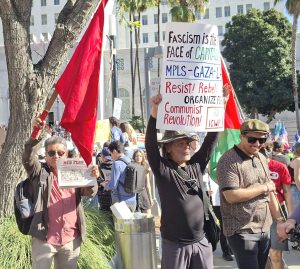
Our party arose in a period of capitalist crisis and mass struggle. The “Occupy” movement in the US and elsewhere. The “Arab Spring.” This is another such period, galvanized by the Gaza genocide and open fascism. There are huge opportunities for us to grow.
We need to develop, spread, and enact the best possible understanding of mobilizing masses for communism.
—Fired-up comrade
Read the ICWP manifesto Mobilize the Masses for Communism here
Bullying: Violence in a Competition-based System
Every morning knowing that they will make fun of her clothes, her body, her way of speaking. Being isolated at recess. Humiliating messages. Arriving home in silence. Not wanting to say anything. To begin to feel less, to doubt her own worth. Wondering if she herself is the problem.
That pain is not an exaggeration. It’s real. Anxiety. Insomnia. Depression. Constant fear. There are young people who stop studying. Others self-harm. Some, tragically, can’t take it anymore. Situations that many young people live day by day as a result of bullying.
In schools, in neighborhoods, in digital networks, bullying is usually presented as an “individual problem,” as a lack of values, or as simple juvenile cruelty. But from a communist perspective we must state clearly: Bullying is not born in a vacuum. It is born in a capitalist society organized on competition, inequality, and the humiliation of the weakest.
Capitalism teaches us to compete, not to cooperate. From childhood we are taught to “be better than others,” to stand out individually, to measure human value according to performance, appearance, or material success.
In this fertile ground, the logic of harassment grows: the strong impose, the popular dominate, the one who has resources humiliates the one who lacks them. Violence is not a deviation from the system. It is its daily reflection.
The capitalist school reproduces social hierarchies. Classify, label, and exclude. The children of the working class are burdened with economic precariousness, discrimination, and a lack of institutional support. Differences in class, gender, sexual orientation, or cultural identity become reasons for aggression. Bullying is the micro-expression of the structural violence of capital.
The system that normalizes labor exploitation, extreme inequality, and ruthless competition cannot aim to foster solidarity among individuals. The same order that legitimizes the accumulation of obscene wealth by a minority while millions survive in precarious conditions, reproduces in the classrooms the logic of domination: a few above, many below.
The position of the International Communist Workers’ Party (ICWP) maintains that the real eradication of bullying cannot be achieved through moral campaigns or disciplinary regulations alone. It is necessary to transform the material basis of society.
In a communist society, education will be oriented towards cooperation, equality, and collective development.
Communist society does not educate people to compete but to collaborate. It does not train them for individual accumulation but for the common good. Where exploitation and structural inequality disappear, so too do the social roots of systematic violence among peers.
It is not enough to condemn bullying. We must point out its origin. And its origin has a name: capitalism.
The fight against bullying is also part of the fight for a new society. Let’s not reproduce the logic of the oppressor.
Let’s organize ourselves to transform everything!
Join ICWP and distribute Red Flag.
—Comrade in El Salvador
Please send your letters, responses, and suggestions to contact@icwpredflag.org