
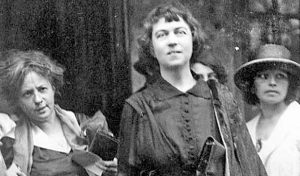
Alexandra Kollontai on Communism and the Transformation of Everyday Life
LOS ANGELES— “What got Alexandra Kollontai exiled from the Soviet Union to Mexico in 1927?” asked Lucy. “Was it really that she angered some monks and a countess in providing housing for veterans and orphans? Or because of her radical rethinking of love? Or something else?”
We were reading Arise, by Christina Heatherton, about the fight for internationalism in the era of the Mexican Revolution. “She brings a lot of strands together,” said Armando. “And you can see that internationalism is not automatic. You’ve got to fight for it.”
“I said that at her book signing,” replied Lucy. “But this chapter about Kollontai isn’t very convincing. It leaves out a crucial fight going on in Russia in 1921.”
“I don’t really know anything about that,” said Guamá. “Enlighten me.”
After the 1917 Bolshevik Revolution, civil war and mass disruption dramatically threatened the survival of children and families. During “war communism” (1918-21) the Bolsheviks established public dining halls, free food for children, wages paid in the necessities of life rather than money, and state rationing of commodities.
Many communist women, including Kollontai (the only woman on the Bolshevik Central Committee in 1917) saw this as a chance to implement their ideals about transforming everyday life. Most party leaders, however, saw it as only an emergency measure. They agreed with Marx that advancing to communism had to wait for industrialization and abundance.
When the civil war ended in 1921, the Bolsheviks had urgent problems in even maintaining power. They hadn’t built a mass base among agricultural workers, the vast majority of the country. They had fought for “peace, land, bread,” not communism. These errors prevented them from overcoming divisions between rural and urban workers.
And the revolution in the rest of Europe that they had expected at the end of World War I was defeated before it began.
The 1921 Tenth Party Congress faced starvation in the cities and uprisings of workers, peasants, and soldiers. There were hundreds of thousands of starving, homeless, and abandoned or orphaned children. Was the way forward to extend “war communism” into a fight for communist social relations and institutions? Or to retreat to capitalism to build up the “productive forces” through industrialization?
This debate centered largely around industrial unions. Kollontai spoke for the Workers’ Opposition. She argued that the Party was stifling workers’ initiative which would be crucial to building communism. Unions, the organizations of industrial workers, should play a much larger role in making decisions about production and distribution.
The Congress adopted instead Lenin’s formulation that unions should be “schools for communism.” It condemned the Workers’ Opposition. Trotsky and Lenin made sexist personal attacks on Kollontai.
The way was then clear for adoption of the New Economic Policy (NEP), a money-based economy with openly capitalist social relations. A year later, Kollontai was nearly expelled from the Party. Instead, she was sent to Norway to negotiate an agreement to trade herring for wheat. Later she was exiled to Mexico.
In Norway Kollontai wrote a letter to youth calling for comrade-love (Make Way for Winged Eros). She wrote Love of Worker Bees, stories sharply critical of NEP.
Vasilisa, the main character, a communist organizer, struggles to organize a communal living arrangement in her hometown while separated from her comrade husband. When she travels to meet him, she finds that he has become a NEPman, a factory manager. He boasts about his luxurious house, scolds his wife for shaking hands with the maid, and engages in an affair.
Vasilisa begins political work among the factory workers and invites them to their home. Her husband accuses her of harboring the enemy. The contradictions sharpen. Vasilisa, pregnant, leaves him to go raise her child in a communal living arrangement.
“What if, instead of concentrating on Make Way for Winged Eros, Heatherton had concentrated on Love of Worker Bees,” asked Lucy. “Love of Worker Bees is a sharp attack on the main contradiction of the New Economic Policy—of communists building capitalism. That could actually get you exiled to Mexico City.”
“That’s what you should have asked Heatherton,” said Guamá.
“Send her this article,” concluded Armando. “See what she says.”
Read our pamphlet The Communist Fight Against Sexism here
More about the fight against sexism here