
Capitalists Start Wars, Workers Fight Them here ♦ Developing Young Communist Leaders here ♦
Capitalists Start Wars, Workers Fight and Die in Them
LOS ANGELES (USA), March 6— “When something happens around the world, we know we can ask you about it, mister,” a high school student told his teacher.
And why not? After all, educators must teach students how to interpret the world around them in order to make the revolutionary change that ICWP seeks.
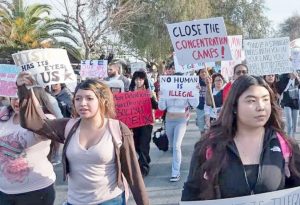
This week, a student asked about the 165 girls in an Iranian school who were killed by US bombs. This same student attempted to organize his friends to walk out against ICE three weeks ago but was stopped by the principal. The discussion about the Iranian schoolgirls led to talking about how during war it is always innocent civilians that are killed.
The next day, while reading a news article about the US/Israel attacks on Iran, another student asked if it was possible for the atomic bomb to ever be dropped on anyone.
“How about here in the US, mister?” asked the student.
The teacher quickly changed the lesson to cover the atomic bombings of Hiroshima and Nagasaki on August 6 and 9, 1945. The student’s eyes opened wide in amazement. Why did we never learn that the US is the only country that has used an atomic bomb against another country. In one week, they killed 200,000 civilians. (In Iraq the US imperialists killed about the same number between 2003 and 2011 with conventional weapons.)
Since January, on the first school day after winter break, there have been intense political conversations in this communist teacher’s class, including discussions about the ICE murders. ICE accomplished its goal to spread fear and terror no matter the cost of lives, lawsuits, and legality. Fear is already deeply established in all working-class communities, immigrant or not.
The teacher led a discussion about the fightback against ICE raids, the deaths of immigrants in ICE custody, and the murders of Keith Porter Jr., Renee Good, and Alex Pretti. They are from exactly the same working class as the seven (or more) US soldiers that have been killed in this current war.
We talked about who is sent to fight and die in these capitalist wars. Soldiers on all sides are part of the international working class. Military men aand women come directly from the working class. Trump has a 21-year-old son, Barron. Students wondered why he is not being sent to Iran in uniform.
The capitalists of the world make the decisions, and they give guns to people who had no say in starting the war. But those people can help make communist revolution that can end the system that inevitably creates all these wars.
From organizing an anti-ICE walkout to protesting imperialist wars, organizing will never stop. It is the role of communists to fight within these struggles for communist revolution.
These working-class students can potentially become revolutionaries within this military infrastructure. Our party has a history of winning young communists to join the military to organize for communism.
Young people in high school are thinking about these world issues. They are teeming with energy to speak up about what’s happening and learn about how we can organize a better society. That society is communism.
We must organize these youth to attend our May Day dinners and march on May Day 2026 and join ICWP to build the revolution that can put an end to war and fascism for good.
Letter: Teaching Critical Thinking and Developing Young Communist Leaders
“Hey Mister, did you hear we blew up Iran?” Johnny asked Monday morning in class.
I paused and asked back, “Who is ‘we’?”
That question immediately got students talking. Some wondered out loud if this meant we were heading toward World War III. Jackie raised her hand and asked, “Mister, how did all this even happen?”
By Friday, it was still on their minds. So before we started our math work, I opened up a short conversation about it. After our discussion we watched two TikToks. A lot of students were quick to blame Trump. Instead of arguing with them, I tried to shift the discussion.
I asked them, “If there is a wider war, whose kids will actually be fighting it? Trump’s kids? The leader of Iran’s kids? Or kids like you?”
“Kids like us,” Mark replied, unsure.
That question changed the tone of the room. Students started thinking about how wars are usually fought by working-class young people.
“My brother joined the military because he wanted a chance at college, job training, or some kind of stability after high school,” Jackie added.
Teaching in the United States, I see students trying to make sense of global conflicts that feel far away. I have to help students understand that these global conflicts involve them in real ways. Their understanding often comes from headlines, social media, or quick political takes. But when you slow the conversation down and ask the right questions, students start thinking more deeply about what class they come from and the difference between the workers and the bosses.
Moments like that remind me that the classroom isn’t just about the material in the textbooks. The classroom is one of the few places where young people should be able to stop, ask questions, and think critically about the world they’re growing up in. It is also a good place to develop young communist leaders.
—Los Angeles (USA) high school teacher
Read our pamphlet Soldiers, Sailors, Marines: Crucial to a Communist Workers’ Revolution here
Read Communist Education for a Classless Society here