
End Wage Slavery and Imperialist War
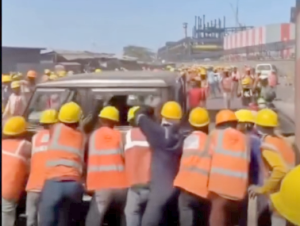
CHENNAI (India), March 9— “Everyone halt work!” Thirty thousand workers at the state-owned Indian Oil Corporation Limited (IOCL) in Panipat walked out. The largest refinery in India came to a grinding halt. The angry workers confronted two thousand heavily armed, specially trained police.
Two days earlier, two workers were killed in an industrial accident. This news spread like wildfire after thousands of workers went on strike. They demanded reduced duty hours from twelve to eight hours, timely wages, access to drinking water and toilets, and a hospital near the refinery.
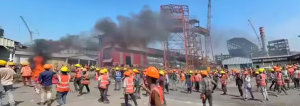
The news of the IOCL strike spread quickly to Surat, five hundred kilometres away. More than five thousand industrial workers from ArcelorMittal Nippon Steel (AM/NS) violently confronted police. They set scores of police vehicles on fire.
Our International Communist Workers’ Party auto workers’ collective met to discuss the strike wave spreading across India. Just as comrades were arriving, we heard that war had broken out in Iran.
Organize Industrial Workers into ICWP
A new comrade who proudly joined ICWP six months ago gave a short report:
“Comrades, our small collective can be a catalyst for mobilizing the industrial workers for communism. Through Red Flag, we know workers in Panipat and Surat. Their plight is our plight. We hear that capitalist bosses have created unbearable conditions. The workers at the refinery who produce vital petrol have no clean water to drink. They have to wait months to get paid. The steelworkers in Surat live in overcrowded slums. These are the contradictions that capitalism has created. Only mobilizing for communism, ending wage slavery and surplus value, will make a permanent change.”
The most important agenda item was the beginning of World War III, which was just unfolding in Iran. Many comrades and coworkers know many people living in the Gulf countries. They are construction workers and refinery workers. They work in warehouses and in cargo delivery. More than nine million workers save their wages to help their families.
Capitalists Are Killing the Workers Who Produce Their Profits
A young comrade, who just started work at Isuzu a few months ago, presented a clear vision for organizing for communist revolution:
“We want to develop a new generation of industrial workers to be communists. This is our biggest opportunity, as Gen Z has shown. The immigrant Gulf workers, those in Panipat and Surat, have the same material conditions as the refinery workers in Tehran and the garment workers in Bengaluru. They are accumulating enormous profits for the capitalists, and the capitalists use this profit to eliminate them. That is the contradiction. They want us to make a profit, but they are bombing us, as in Iran and the Gulf countries. You cannot make a profit by physically eliminating workers who produce profit. You see that in the ICE gestapo in the US.”
We can reach out to thousands of industrial workers immediately. We distribute about five hundred copies of Red Flag. We have readers in Panipat, Surat, and, formerly, garment workers in Sri Lanka. We will immediately start distributing Red Flag to our friends in the Gulf countries. The severe water scarcity there will be followed by food scarcity. The immigrants who make up 90% of the workforce can become a potent force for change.
The impending world war can only be opposed with a communist vision of the beginning of a new dawn, where the profit system will not exist. Our capitalist oppressors paint a gloomy picture because they are in decline.
“My grandfather told me about a navy ship in Chennai in 1946,” said a comrade. “It started with food riots. The British colonial power tried to divide Hindu and Muslim workers by offering preferential treatment. When the sailors united with the communists, it sent shock waves. It spread from Mumbai to Chennai and reached Iran. It ended the colonial domination.
“But it was not a fight for communism,” he concluded. “It replaced the British capitalists with Indian capitalists. We must organize for a communist revolution now.”