Letter: Communism Is Our Future
South Africa, May 31— This weekend, over twenty comrades attended a two-day outing. There were old and new comrades, mostly young women. Some are still in high school. Some are .
ICWP has clearly shown that socialism was state capitalism. Instead of leading to communism, it led to creating a new ruling class of capitalists who profited from wage slavery. The Bolsheviks didn’t want that. They thought that socialism would lead to communism. History proved otherwise.
But the Russian revolution inspired the masses worldwide and showed the need for a party that leads the ideological and practical fight to overthrow capitalism. It showed the key role of workers and soldiers in winning power. It showed the fight must be for communism, not socialism.
This series seems to say we have much to learn from the anarchists. Maybe they were correct in some criticisms of socialism, but that doesn’t make anarchism a positive alternative. The anarchists united with the capitalists in Russia and repeatedly around the world.
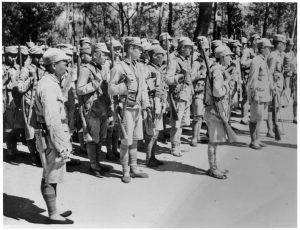
The headline on the box claims that ICWP was wrong about war communism. I understand that in what is called “war communism,” people worked and fought without money for the common good. This also happened during the protracted war led by the Chinese Red Army. Millions of people, mainly peasants, fought the Japanese invaders and the national capitalists for twenty years. They had a communistic lifestyle without material incentives. They collectively grew food and fought without anyone having special privileges. They learned to read by learning characters while marching.
In guerilla camps in Vietnam, masses fought French and US imperialists for forty years. They lived, fought resolutely, and produced their tapioca without money. They defeated the imperialists in battle.
In El Salvador during the war in the 1980’s, people fought and lived without money. Some say it was the best time of their lives. This was the masses’ experience in Leningrad and Stalingrad during the battle to defeat the Nazis.
Unfortunately, each time, after the emergency, money, wages, rank, and privilege were re-instated.
Surely Soviet War Communism had many flaws. These were due to the basic error of fighting for socialism and underestimating that peasants could be won to communist collectivity. After the revolution they tried both appropriation and opening up markets. But when food was needed with no money, they requisitioned it.
But in emergencies, especially war, most of the masses worked and fought collectively for the common good without money. They are open to fighting for and implementing communism—both during emergencies and after the emergency is over if/when there is a party committed to communism.
They will produce and live without material incentives. Comradely relations of collectivity will replace money—all the time.
ICWP is the only international communist Party that fights for communism, and nothing less. This requires mass collective leadership, not the state bureaucracy which socialism needs.
War communism, with its flaws, showed the masses can and will fight, live, and work collectively without money. Communism is our future—during wars, other emergencies, and all the time. Showing the errors of socialism is important. But let’s be dialectical. We don’t need to throw cold water on the concept of war communism.
—One of many critical thinking Comrades
Red Flag responds: Thank you for summarizing key aspects of our Party’s line. Yes, the masses can and must be won to fight directly for, and then build, communist society. Nothing in the box whose headline the letter criticizes, or in the article series it accompanies, contradicts that line.
The question is the extent to which Soviet “war communism” (1918-21) corresponded to the communism we plan to build. The article series looks more closely at the historical record than we have previously. That includes speeches and reports of Lenin and others.
These show that some “people worked and fought without money for the common good.” Mainly the most advanced factory workers in large cities. But not most, especially in the countryside.
The Bolsheviks did not win masses to fight for communism. Their slogans were “peace, land, bread” and, later, “all power to the soviets.” Many supported their policies but didn’t understand or embrace communism itself. When the old regime was finally defeated, contradictions sharpened among the masses and within the party.
The Bolsheviks did not abandon “war communism” because they believed in socialism. They abandoned it in a desperate effort to maintain power in amidst economic chaos and the threat of a new civil war.
Crops failed in 1920. Production was a fraction of pre-war levels. Many factories were in shambles. Many workers had returned to the countryside. Anti-Bolshevik peasant rebellions were breaking out. Kronstadt sailors rebelled. Lenin feared that the Bolsheviks could not stay in power without a change in direction.
It’s hard to say, even in retrospect, what they should have done in that tragic situation. One thing we have learned from the Bolsheviks’ heroic struggle is that they should have been fighting much harder to win the masses to communism all along. And, as the letter says, that is what we strive to do now.
Finally, the letter claims, without evidence, that “this series seems to say we have much to learn from the anarchists.” We think that those who read the articles will see this is not true. Quite the contrary.
Please send your letters, responses, and suggestions to Contact@ICWPRedFlag.org