Dialectical Materialism 2.0 here ♦ From Theory to Practice here ♦ New Words, Old Mistake here ♦
Letter: Dialectical Materialism 2.0
The ICWP is a party of struggle, and our philosophy is dialectical materialism (DM), the science of conflict. Yet sometimes the current version of DM is one sided.
A general principle of dialectics is that if you talk about a subject, you also talk about its opposite. We talk about struggle, so we should also talk about the opposite of struggle. What is that?
I believe the opposite is “alliance,” though sometimes “entente” (French for “understanding”) is more appropriate. I believe we don’t give enough attention to the study of alliances.
What brought this home to me was the situation in the Mideast. After the US/Israeli attack there was weeks of all-out struggle.
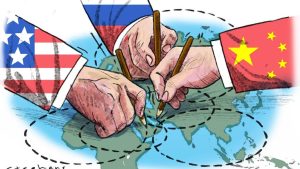
But then came the cease-fire and I would argue that the two sides formed a de facto alliance. They are trying to work out a deal which, I believe, would involve dividing the tolls collected from a reopened Strait of Hormuz.
Obviously, there are still contradictions, but these are, I believe, just haggling about the terms of their alliance, i.e. about who gets what. If they can’t come to an agreement soon, shooting may break out again and contradictions come to the fore.
The other big alliance is Israel and the US. They have their differences (struggles), but these are within the context of a solid entente in which they cooperate against Iran.
I feel we need an updated version of DM which takes alliances into account. After all, we will be confronted with powerful alliances and will have to form alliances of our own.
I’ve worked out a few of the rules of what I call DM 2.0, but I’ll only give a couple here.
The basic notion is what I call a duo, a pair of opposites united but struggling. If struggle is primary, it’s a contradiction. If unity is primary, it’s an alliance.
In any duo, one side is dominant – has the upper hand. This is true even of alliances. For example, in the Israel/US alliance, the US has the upper hand.
Another rule is that inside every alliance there are contradictions, and inside every contradiction there are alliances. We’ve seen examples of contradictions inside alliances, but alliances inside contradictions?
Again, the Mideast gives an example. Even during the hot war phase there was an unspoken agreement (entente) not to attack the water desalinization plants.
These ideas have historical precedents. Two hundred years ago the Prussian General/Philosopher Clausewitz argued that there are two kinds of wars, “limited” and “unlimited.” A limited war is one whose goal is to extract a concession, whereas in an unlimited war at least one side aims to annihilate the other. I believe his limited war concept corresponds to a contradiction inside an entente. I also think there is an analogous rule about contradictions in general, not just wars.
Reformism at best conducts a limited war against capitalism. Reformists have an entente with capitalism. But as communists we advocate unlimited war against capitalism – we aim to annihilate it.
—Comrade in Canada
Letter: Dialectical Materialism: From Theory to Practice
The letter “Dialectical Materialism 2.0” posits that in a system there are contradictions. That is to say, there exist “alliances” between two opposite and contradictory forces. It suggests the view that two opposite forces that contradict each other do not necessarily mean there is a conflict and struggle all the time. That sometimes there is unity or alliance between these forces. And this happens whenever there is an agreement between these forces.
The example it gives is the temporary fragile ceasefire between Iran on one side and the United States on the other side.
I take an opposite view: that the shooting war between the US and Iran is not some sort of new appearance of a contradiction. Rather, it is the intensification of these contradictions in the process of a resolution.
The 2015 US-Iran nuclear deal did not represent an alliance between these opposing forces. And the ceasefire, too, does not represent an alliance between the two. The absence of kinetic war between these forces does not mean that the contradictions between the US/Israel and Iran became secondary. They were always primary.
The main contradiction is that the US seeks to undermine, and ultimately destroy, the Iranian ruling class as it currently exists. And, on the other hand, Iran seeks to undermine and destroy US dominance in the region and ultimately drive it out. These contradictions are primary. And they do not stop being so in the absence of shooting war.
The kinetic war is thus a stage in the process of the struggle between these contradicting opposite forces. Negotiations are tools. Just as missiles are tools used by either party to get what it wants, which is to destroy the other. Therefore, any unity between them is temporary and secondary and the struggle is primary and permanent.
Similarly, there is no workers’ revolution currently taking place against the world capitalists. Workers still bargain with capitalists in different industries. However, that does not represent an alliance between these opposing contradictory forces. Nor does this bargaining mean the “alliance” or “unity” between workers and bosses is primary and permanent.
When a communist revolution takes place, it will be as a result of the intensification of contradictions between capitalists and workers. The struggle between these forces is the essence of these contradictions.
—Industrial worker comrade in South Africa
Letter: New Words for an Old Mistake
The comrade’s “updated version of dialectical materialism” is not new at all.
The letter defines a “duo” as “a pair of opposites united but struggling.” This is the classical definition of a contradiction.
Then it identifies two kinds of “duos” (contradictions). “If struggle is primary, it’s a contradiction. If unity is primary, it’s an alliance.”
A “contradiction” in the comrade’s vocabulary is what we have always called a contradiction. The comrade’s “alliance” is what revisionists have called a “non-antagonistic contradiction.”
Our late beloved Comrade Tom Weston explained that Soviet philosophers developed this mistaken concept in the early 1930s. They used it to claim that Soviet social contradictions could be resolved without becoming intense or leading to social upheavals. This proved to be false.
The Chinese Communist Party used the same idea to justify its attempt to defeat Japanese imperialism by uniting with Chiang’s bourgeois nationalists, instead of by fighting for communism. This cost the Chinese masses and the party dearly.
Our party rejects the revisionist notion of “non-antagonistic contradictions.” Revisionism means gutting revolutionary communism instead of advancing it.
Dialectical materialism is the collective product of generations of communists. It has been developed and tested in the crucible of class struggle. Doubtless it can and will be improved further. But not the way the comrade is going about it.
—Comrade in Los Angeles (USA)
Read Tom Weston’s article The Concept of Non-Antagonistic Contradictions in Soviet Philosophy (2008) here
Learn more about Dialectical Materialism here
Please send your letters, responses, and suggestions to Contact@ICWPRedFlag.org