Learning to Walk here ♦ Young Comrades Build ICWP here ♦ Letter: Break the Chains here ♦
Learning to Walk the Communist Walk
South Africa, May 31— This weekend, over twenty comrades attended a two-day outing. There were old and new comrades, mostly young women. Some are still in high school. Some are in college.
We went to learn dialectical materialism and how to use it to change the world around us and bring about communist revolution. We learnt that dialectical materialism is a philosophy of change. It teaches us that dialectical contradictions drive change. If we are to change the world, we must investigate dialectical contradictions of capitalism. And understand contradictions in ourselves as individuals in a collective.
Almost all comrades said at the start that they want to learn and understand dialectical materialism to be able to recruit more people. We aimed to use real-world everyday experiences so that our understanding of dialectical materialism, contradictions, and change is rooted in concrete reality. Instead of being too abstract and theoretical.
Contradictions are everywhere. They can either make development or prevent it. And there are laws of dialectics.
One comrade used the example of a toddler. When toddlers are learning to walk, they don’t have strong legs or balance. The toddler tries again and again to take steps but falls. This shows a law of dialectics: the law of quantity to quality. By making repeated attempts, quantity turns into quality as the leg muscles learn to balance and become strong enough to walk.
It also shows the law of negation of negation. When the toddler grows to become a child, it will never become a toddler again. And when the child becomes a big kid, it will never be a child again.
This is true of our collective and party. Once we grasp dialectical materialism, we will never again not know it. This qualitative change makes more quantitative change possible. We don’t have to go backward from twenty comrades. We can become forty comrades and so on.
Comrades clearly understood this. One remarked that if we do something just once we can never get it right.
Another comrade said, “Expanding our knowledge of dialectical materialism would represent a qualitative change in our political understanding. But we cannot make that if we do not repeatedly have a struggle. Take repeated steps like a toddler to learn more. If we only meet once, we cannot turn quantity into quality”.
We understand that in our collectives we have our own contradictions. One is the lack of consistent struggle and commitment to attend meetings.
One comrade said, “Like a seed that you have to water constantly, we must also water our comrades and collective to have constant struggle. That is the only way we can learn and turn quantity to quality. And also use that quality (better understanding of dialectical materialism and communism in general) to turn into quantity of recruiting more numbers. Because we would be confident.” And we can answer questions from the masses.
One new young comrade who has distributed Red Flag was quite illuminated by our discussions. She remarked, “This dialectical materialism will help us when we are talking to people. It shows us change is possible and how we can change capitalism. This will help because sometimes people are rude when we distribute. They tell us this will never happen, but I know it can happen”.
Centering our discussions around real concrete examples helped us learn about our own collective contradictions, strengths, and weaknesses. We investigated and asked questions.
One contradiction is that we know we should read the Red Flag, but we don’t read it as we should. Some comrades do not read at all. To overcome this, we decided to have weekly article discussions on our WhatsApp group to encourage comrades to read and ask questions.
Also, two comrades in South Africa will regularly attend the Red Flag Zoom meetings so that our collective’s perspective and feedback can be communicated better to the Red Flag collective. Like in the case of a toddler, the Red Flag is our heartbeat, bringing oxygen and allowing us to make strides in recruiting the masses. It helps us learn from our successes and our failures.
Comrades clearly understand dialectical materialism better than when they came. They see dialectics as real and concrete. Not as something abstract that only a few experts can understand. Comrades have renewed a sense of commitment. We plan to do much more than we did before as we continue to mobilise the masses for communism.
A child and mother form a bond for life. And no money is exchanged for a toddler learning to walk. Likewise, we can have communist relationships with the masses. And we can build a true communist society without money.
Dialectical Materialism Helps Young Comrades Build ICWP
SOUTH AFRICA, May 31— “When rent goes up and wages don’t, don’t ask ‘why are landlords so greedy?’ Instead, ask ‘what are the material conditions that make landlords demand more rent?’ The answer is: Private ownership of land and housing under Capitalism,” said Comrade Andy.
This was during our very successful dialectical materialism class. The group consisted of over twenty eager comrades. The majority were youth who are still students. To see such fresh minds who are part of our communist struggle was a breath of fresh air.
On Friday, May 29, the comrades gathered from different parts of town. The Friday session started late with a brief introductory session followed by supper in true communist style. All the comrades contributed to cooking, cleaning, and washing dishes. The comrades had an early night in preparation for a full day of classes on Saturday.
On Saturday morning, our most punctual comrade, Comrade Cindy, knocked on everyone’s doors to ensure everyone was awake. The first session started with breakfast at 9:00 AM followed by the opening study session at 10:00.
Comrades gathered together in one group where a presentation on the current situation in Gaza was shared. Comrades were appalled by the inhumane conditions that our fellow comrades in Gaza have to endure. “It is truly heartbreaking and sad. No human being deserves to go through this,” said one Comrade. The comrades proceeded to discuss their feelings and opinions about the situation in Gaza.
The group then separated into two smaller groups to get into dialectical materialism discussions. First, all the comrades set goals as to what they would like to achieve from the day’s proceedings. Most cited that they would like to get a better understanding of dialectics in practice. How it ties in with our daily lives and how a war that started so far away from South Africa has an impact on how we live in South Africa.
Most comrades also said they would like to learn more about ICWP. And how to be more appealing to people when trying to recruit new comrades to mobilise the masses in the struggle for communism.
The teams took a lunch break and after lunch they got together in a bigger group for the second and last session. The group had a feedback session on shortcomings in reading the Red Flag. The team shared some constructive ways to encourage reading. They cited more pictures on the front page to create a feeling of excitement and interest before you even open the newspaper.
After this, the team had an open mic session to share any thoughts they had regarding ICWP, the struggle for communism, and how comrades can grow the party. All the comrades had planned speeches that they wrote and shared with the rest of the comrades. We share the same struggles, all in the fight for change.
The spirits of the comrades were very high. The session ended off with a braai (barbecue) where the team gathered together to share a meal and thoughts about our successful day.
Letter: Break the Chains of Modern Slavery
When we look back at history, we often view slavery through a single, physical, lens: iron chains, high fences and forced labour.
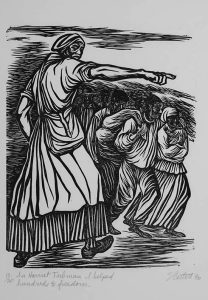
But Harriet Tubman, one of the greatest freedom fighters in human history, understood a much deeper, darker truth. She famously implied that the hardest part of her journey wasn’t just breaking physical chains. It was breaking the mental ones.
She had to convince people who had been enslaved their entire lives that their masters were not their lifelines. She had to fight a system that conditioned human beings to believe that the very person oppressing them was the only one who could help them survive.
Harriet succeeded in doing this and she was alone. There are plenty of us, which means we could make a change.
It’s easy for us to sit here in the 21st century and think, “That was then, and we are more advanced.”
But if you look closer…
The psychological cage Harriet Tubman fought against did not disappear. It evolved. Today it wears a suit, and speaks in complex economic terms through advanced, invisible systems.
Today, modern slavery: where millions are trapped in predatory debt and trafficking, facing dependence on abusive employers for survival. This contemporary dependency serves as a direct parallel to historical exploitation, sustaining the cycle of forced labour.
—Twelve-year-old comrade in South Africa
Read more about the communist philosophy of dialectical materialism here
Please send your letters, responses, and suggestions to Contact@ICWPRedFlag.org