
Soviet Russia in 1918: Famine and “War Communism”
The last article described contradictions between and among anarchists and communists through the November 1917 Bolshevik revolution.
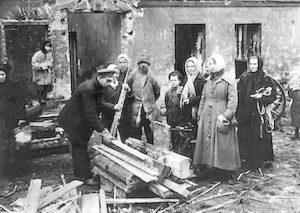
“Famine is a calamity which sweeps away all other questions,” Lenin declared in June 1918.
Wartime Russia suffered critical food shortages. The Czarist government prioritized sending food to the front. It drafted ten million peasants, creating a shortage of agricultural labor. Fertilizers and agricultural equipment were scarce.
Peasants understandably stored grain instead of selling it. Urban food supplies declined. Over 15% of the population lived in urban areas. But under 8% of grain reached the market. Results: High prices, profiteering, adulteration of foodstuffs. Hunger.
Masses took things into their own hands. Some formed political consumer co-operatives. Many participated in food riots, shouting anti-war and anti-government slogans. Twenty food riots in 1915. Two hundred eighty-eight in 1916. Too many to count in 1917. Soldiers joined. Police fled.
The Tsarist government fell in February 1917. Seven months later, communist-led workers, soldiers, and sailors took power. But the food crisis remained.
Class Struggle and Land Ownership
Traditionally, most Russian peasants farmed under the mir system of communal peasant landownership. Anarchists expected this to evolve into a federation of local free communes. But the mir had allocated plots of land to peasant families, rather than cultivating land collectively. That system, Lenin explained in 1908, had supported the power of serf-owning landlords and their heirs.
After the failed 1905 revolution, the bourgeois minister Stolypin advocated “Land Reform.” He intended to destroy feudal power while isolating peasants from the Bolsheviks. Lenin described Stolypin’s method as “the forcible destruction of the village commune and the accelerated ruination and extermination of the mass of impoverished owners for the benefit of a handful of kulaks.”
Stolypin aimed to privatize communal peasant land, bringing peasants into the capitalist marketplace. This weakened the communes. But Russian peasants clung to communal land ownership. Stolypin’s reform was limited. Many peasants ended up worse off.
By 1917, 40% of peasants couldn’t survive on the land. As many as one third were wage laborers.
Socialist Revolution in the Countryside
“The first duty of the government of the workers’ and peasants’ revolution must be to settle the land question,” Lenin declared.
Left Socialist-Revolutionaries (not Bolsheviks) wrote the November 1917 “Decree on Land.” They based it on a “Peasant Mandate” drawn from 242 local peasant-written platforms.
The Decree abolished private property in land. It confiscated, without compensation, large private, crown, and church estates. Elected land committees and Soviets of Peasants’ Deputies would control the land. Bolsheviks hoped to establish socialist collective farms (kolkhozes).
But Lenin’s detailed February 1918 Decree on Land Socialization showed how complex land ownership was. And famine was compounded by civil war and the flu epidemic brought by Allied intervention. Industry was still in shambles.
Mobilizing Factory Workers to the Countryside
The Bolsheviks’ solution was “war communism.” Its key was a state grain monopoly. It would requisition agricultural surplus from peasants and ration food for the urban population.
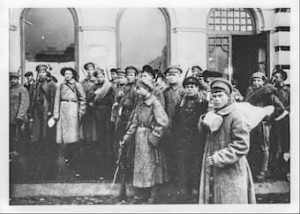
Industrial worker detachments mobilized to confiscate excess grain (with compensation) from well-to-do peasants (kulaks). But factories were producing war materiel, not consumer goods peasants could buy.
Worker detachments helped with planting, harvesting, and transporting foodstuffs to collection points. They mended and loaded carriages. They guarded transport routes and food stores.
Some helped organize poor peasants into communist-led kombedy. These bodies identified grain surpluses, organized grain collection, and redistributed grain. They stopped market transactions and speculation. Some food detachments joined local soviets and helped establish Bolshevik party cells.
By late 1918, there were about twelve thousand food supply detachment workers in the Volga region alone. This worked in places like Eletz, a major agricultural hub, where there was already some class consciousness.
But other peasants – including local soviets – resisted massively. Many felt cheated and oppressed.
The Bolsheviks realized that they had overestimated the willingness of rural workers to join kolkhozes.
But the main problem – we now understand – was that the Bolsheviks did not mobilize those detachments to fight for actual communism. To take a sharp class line to the kombedy and rural wage laborers. To organize communist study as well as party cells.
Bolsheviks had fought for “peace, land, bread” and socialism, not for communism. Political leadership, not ideological leadership. “War communism” was not a classless society based on collective work and decision-making.
We have learned from Bolsheviks’ heroic struggles that to win that classless society we must mobilize masses for communism, nothing less.
Next: Anarchists saw in the peasant unrest an opportunity for their “third revolution.”
Read previous articles in this series here